Skip to main content
Microbiology
My Course
Learn
Exam Prep
AI Tutor
Study Guides
Textbook Solutions
Flashcards
Explore
Try the app
My Course
Learn
Exam Prep
AI Tutor
Study Guides
Textbook Solutions
Flashcards
Explore
Try the app
Back
Discovering the Structure of DNA quiz
You can tap to flip the card.
What technique did Rosalind Franklin use to capture photo 51?
You can tap to flip the card.
👆
What technique did Rosalind Franklin use to capture photo 51?
Rosalind Franklin used x-ray diffraction to capture photo 51.
Track progress
Control buttons has been changed to "navigation" mode.
1/15
Related flashcards
Related practice
Recommended videos
Discovering the Structure of DNA definitions
Discovering the Structure of DNA
15 Terms
Discovering the Structure of DNA
14. DNA Replication
3 problems
Topic
Nicole
Meselson-Stahl Experiment
14. DNA Replication
3 problems
Topic
Brendan
14. DNA Replication
10 topics
14 problems
Chapter
Brendan
Guided course
06:24
Detailed DNA Structure
5
views
Guided course
04:41
Discovering the Structure of DNA
7
views
Terms in this set (15)
Hide definitions
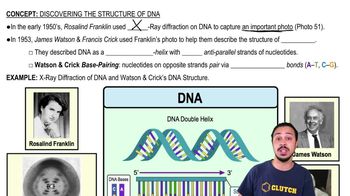
What technique did Rosalind Franklin use to capture photo 51?
Rosalind Franklin used x-ray diffraction to capture photo 51.
What key structural feature of DNA did photo 51 provide evidence for?
Photo 51 provided evidence that DNA has a double helix structure.
Who used Franklin's photo 51 to help describe the structure of DNA?
James Watson and Francis Crick used Franklin's photo 51 to help describe the structure of DNA.
How did Watson and Crick describe the arrangement of DNA strands?
Watson and Crick described DNA as having two antiparallel strands of nucleotides.
What does 'antiparallel' mean in the context of DNA structure?
Antiparallel means that the two DNA strands run in opposite directions: one from 5' to 3' and the other from 3' to 5'.
What are the base pairing rules established by Watson and Crick?
Adenine (A) pairs with thymine (T), and cytosine (C) pairs with guanine (G) via hydrogen bonds.
What type of bonds hold the two DNA strands together?
Hydrogen bonds hold the two DNA strands together between the nitrogenous bases.
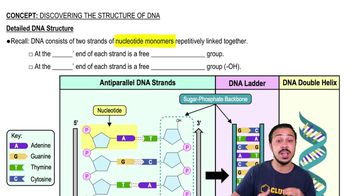
What are the three components of a DNA nucleotide?
A DNA nucleotide consists of a phosphate group, a 5-carbon sugar, and a nitrogenous base.
Which nitrogenous bases are found in DNA?
The nitrogenous bases in DNA are adenine (A), thymine (T), cytosine (C), and guanine (G).
What forms the backbone of the DNA molecule?
The sugar-phosphate backbone, made of alternating sugar and phosphate groups, forms the backbone of DNA.
Where are the nitrogenous bases located in the DNA double helix?
The nitrogenous bases are oriented toward the center of the DNA molecule.
What is found at the 5' end of a DNA strand?
A free phosphate group is found at the 5' end of a DNA strand.
What is found at the 3' end of a DNA strand?
A free hydroxyl (OH) group is found at the 3' end of a DNA strand.
How are the two DNA strands held together?
The two DNA strands are held together by hydrogen bonds between complementary nitrogenous bases.
What is the significance of the sugar-phosphate backbone in DNA?
The sugar-phosphate backbone provides structural support and stability to the DNA molecule.
 BackBack
 06:24
06:24