Skip to main content
Microbiology
My Course
Learn
Exam Prep
AI Tutor
Study Guides
Textbook Solutions
Flashcards
Explore
Try the app
My Course
Learn
Exam Prep
AI Tutor
Study Guides
Textbook Solutions
Flashcards
Explore
Try the app
Back
Discovering the Structure of DNA definitions
You can tap to flip the card.
X-ray Diffraction
You can tap to flip the card.
👆
X-ray Diffraction
A technique that reveals molecular structures by analyzing patterns formed when x-rays pass through a sample, crucial for visualizing DNA's shape.
Track progress
Control buttons has been changed to "navigation" mode.
1/15
Related flashcards
Related practice
Recommended videos
Discovering the Structure of DNA quiz
Discovering the Structure of DNA
15 Terms
Discovering the Structure of DNA
14. DNA Replication
3 problems
Topic
Nicole
Meselson-Stahl Experiment
14. DNA Replication
3 problems
Topic
Brendan
14. DNA Replication
10 topics
14 problems
Chapter
Brendan
Guided course
06:24
Detailed DNA Structure
5
views
Guided course
04:41
Discovering the Structure of DNA
7
views
Terms in this set (15)
Hide definitions
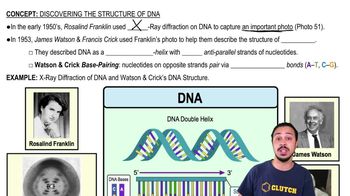
X-ray Diffraction
A technique that reveals molecular structures by analyzing patterns formed when x-rays pass through a sample, crucial for visualizing DNA's shape.
Photo 51
An iconic image showing an x-shaped pattern, providing direct evidence for the helical structure of DNA.
Double Helix
A twisted ladder-like arrangement formed by two intertwined strands, characteristic of DNA's three-dimensional structure.
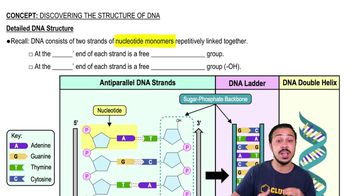
Antiparallel Strands
Two chains running in opposite directions, with one oriented 5' to 3' and the other 3' to 5', essential for DNA's function.
Nucleotide
A building block composed of a phosphate group, a five-carbon sugar, and a nitrogenous base, repeated to form DNA strands.
Base Pairing Rules
Specific associations where adenine aligns with thymine and cytosine with guanine, stabilized by hydrogen bonds.
Hydrogen Bonds
Weak attractions that connect complementary nitrogenous bases across DNA strands, maintaining the double helix.
Adenine
A nitrogenous base that pairs exclusively with thymine in DNA, following Watson and Crick's pairing principles.
Thymine
A nitrogenous base that forms pairs with adenine, contributing to the specificity of genetic coding.
Cytosine
A nitrogenous base that forms stable pairs with guanine, ensuring accurate genetic information transfer.
Guanine
A nitrogenous base that pairs with cytosine, linked by hydrogen bonds within the DNA molecule.
Sugar-Phosphate Backbone
A repetitive chain of sugars and phosphate groups forming the structural framework on the outside of DNA strands.
Nitrogenous Base
A molecular component found in nucleotides, positioned toward the center of DNA, responsible for encoding genetic information.
5' End
The terminus of a DNA strand distinguished by a free phosphate group, indicating directionality.
3' End
The terminus of a DNA strand marked by a free hydroxyl group, opposite to the 5' end.
 BackBack
 06:24
06:24