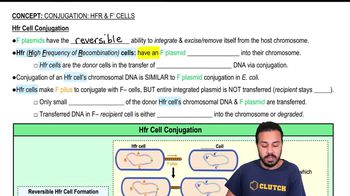
HFR stands for High Frequency of Recombination, referring to cells with an F plasmid integrated into their chromosome.
How is an HFR cell formed from an F+ cell?
An HFR cell is formed when the F plasmid integrates into the host chromosome of an F+ cell.
Is the integration of the F plasmid into the chromosome reversible?
Yes, the F plasmid can excise itself from the chromosome, converting the HFR cell back to an F+ cell.
During HFR cell conjugation, what type of DNA is transferred to the recipient?
Part of the donor cell's chromosomal DNA and a portion of the integrated F plasmid are transferred to the recipient.
Does the recipient cell become F+ after HFR cell conjugation?
No, the recipient cell remains F- because it does not receive the entire F plasmid.
What structure is formed by HFR cells to initiate conjugation?
HFR cells form an F pilus to bind to the F- cell and initiate conjugation.
What happens to the transferred DNA in the recipient cell after HFR conjugation?
The transferred DNA may integrate into the recipient's chromosome via homologous recombination or be degraded.
What is the main difference between HFR and F+ cell conjugation?
HFR cell conjugation transfers chromosomal DNA and only a portion of the F plasmid, while F+ cell conjugation transfers the entire F plasmid.
How are F' (F prime) cells formed?
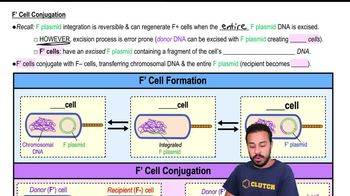
F' cells are formed when the F plasmid excises from the chromosome of an HFR cell, taking a fragment of chromosomal DNA with it due to error-prone excision.
What does the F' plasmid contain?
The F' plasmid contains the entire F plasmid plus a small fragment of chromosomal DNA.
What happens during F' cell conjugation?
The F' cell transfers the entire F' plasmid, including the excised chromosomal DNA fragment, to an F- recipient cell.
What is the result for the recipient cell after F' cell conjugation?
The recipient cell becomes an F' cell, now containing the F' plasmid with the chromosomal DNA fragment.
How does horizontal gene transfer differ between HFR and F' cell conjugation?
HFR conjugation transfers chromosomal DNA and a portion of the F plasmid, while F' conjugation transfers the entire F' plasmid with chromosomal DNA.
Why does the recipient cell remain F- after HFR conjugation?
Because it only receives a small portion of the F plasmid, not the entire plasmid, so it cannot initiate conjugation.
What is the significance of error-prone excision in F' cell formation?
Error-prone excision allows the F plasmid to take chromosomal DNA with it, creating genetic diversity in F' cells.
 Back
Back
 04:31
04:31