Skip to main content
Microbiology
My Course
Learn
Exam Prep
AI Tutor
Study Guides
Textbook Solutions
Flashcards
Explore
Try the app
My Course
Learn
Exam Prep
AI Tutor
Study Guides
Textbook Solutions
Flashcards
Explore
Try the app
Back
Conjugation: Hfr & F' Cells definitions
You can tap to flip the card.
HFR Cell
You can tap to flip the card.
👆
HFR Cell
A bacterial cell with an F plasmid integrated into its chromosome, enabling high-frequency chromosomal gene transfer during conjugation.
Track progress
Control buttons has been changed to "navigation" mode.
1/15
Related flashcards
Related practice
Recommended videos
Conjugation: Hfr & F' Cells quiz
Conjugation: Hfr & F' Cells
15 Terms
Conjugation: Hfr & F' Cells
16. Microbial Genetics
3 problems
Topic
Nicole
Genome Variability
16. Microbial Genetics
4 problems
Topic
Nicole
16. Microbial Genetics - Part 1 of 2
9 topics
14 problems
Chapter
Monica
16. Microbial Genetics - Part 2 of 2
8 topics
13 problems
Chapter
Nicole
Guided course
04:31
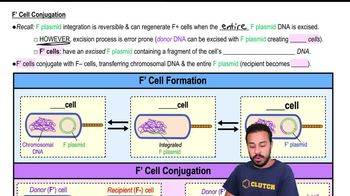
F’ Cell Conjugation
2
views
Guided course
09:41
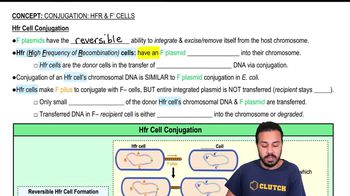
Hfr Cell Conjugation
2
views
Terms in this set (15)
Hide definitions
HFR Cell
A bacterial cell with an F plasmid integrated into its chromosome, enabling high-frequency chromosomal gene transfer during conjugation.
F Plasmid
A circular DNA molecule in bacteria that can integrate into or excise from the host chromosome, mediating conjugation.
F+ Cell
A bacterial cell containing a complete, non-integrated F plasmid, capable of forming a pilus for DNA transfer.
F' Cell
A bacterial cell with an F plasmid that has excised from the chromosome, carrying a fragment of chromosomal DNA.
F- Cell
A bacterial cell lacking the F plasmid, serving as the recipient during conjugation with donor cells.
Conjugation
A process where genetic material is transferred from a donor to a recipient cell via direct contact, often using a pilus.
F Pilus
A surface structure produced by donor cells, facilitating attachment and DNA transfer to recipient cells during conjugation.
Homologous Recombination
A mechanism allowing incoming DNA to integrate into the recipient's chromosome by aligning with similar sequences.
Horizontal Gene Transfer
The movement of genetic material between organisms, not by inheritance, but through processes like conjugation.
Excision
The process where an integrated F plasmid is removed from the host chromosome, which can be precise or error-prone.
Integration
The insertion of the F plasmid into the host chromosome, converting an F+ cell into an HFR cell.
Donor Cell
A bacterial cell that provides genetic material during conjugation, often containing an F plasmid or its derivatives.
Recipient Cell
A bacterial cell that receives genetic material during conjugation, typically lacking the F plasmid.
Chromosomal DNA
The main genetic material of a bacterial cell, portions of which can be transferred during HFR or F' conjugation.
Error-Prone Excision
A faulty removal of the F plasmid from the chromosome, resulting in the plasmid carrying extra chromosomal genes.
 BackBack
 04:31
04:31