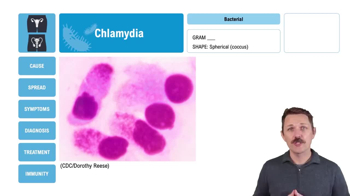
Chlamydia is caused by Chlamydia trachomatis, a gram-negative, obligate intracellular bacterium.
Why can't Chlamydia trachomatis be seen with a standard light microscope?
It is too small to be visualized with a standard light microscope.
What are the two life stages of Chlamydia trachomatis?
The two life stages are the infectious elementary bodies and the metabolically active reticulate bodies.
Where does Chlamydia trachomatis replicate?
It replicates only inside host cell vesicles, making it an obligate intracellular pathogen.
What is the most common bacterial sexually transmitted infection?
Chlamydia trachomatis is the most common bacterial sexually transmitted infection.
How is chlamydia typically diagnosed?
Diagnosis relies on nucleic acid amplification tests like PCR, since the bacteria are too small for light microscopy.
What symptoms can chlamydia cause in males?
Symptoms include dysuria, urethral discharge, burning or itching, orchitis, and epididymitis, but about half of cases are asymptomatic.
What symptoms can chlamydia cause in females?
Symptoms include bleeding between periods, vaginal discharge with odor, itching, pain during intercourse, but about three quarters of cases are asymptomatic.
What serious complications can untreated chlamydia lead to in females?
Untreated chlamydia can cause pelvic inflammatory disease, infertility, and increase the risk of miscarriage.
How can chlamydia be transmitted to newborns?
It can be passed to newborns during birth, causing neonatal conjunctivitis and sometimes pneumonia.
What is the difference between elementary bodies and reticulate bodies in chlamydia?
Elementary bodies are the infectious, inactive form outside cells; reticulate bodies are the metabolically active, reproductive form inside cells.
What antibiotics are effective for treating chlamydia?
Doxycycline and azithromycin are effective treatments, with minimal antibiotic resistance.
Can chlamydia be distinguished from gonorrhea based on symptoms alone?
No, symptoms of chlamydia and gonorrhea often overlap and cannot be distinguished based on symptoms alone.
Does infection with chlamydia provide lasting immunity?
No, there is no lasting immunity, and people can be reinfected with chlamydia.
How can the transmission of chlamydia be reduced?
Consistent condom use significantly reduces the spread of chlamydia.