Back

Chemicals Used to Control Microbial Growth quiz

Control buttons has been changed to "navigation" mode.
1/15
  • What are the two main categories of chemicals used to control microbial growth?

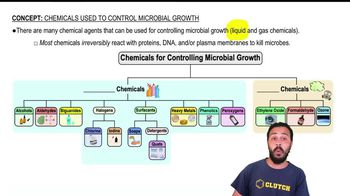
    The two main categories are liquid chemicals and gaseous chemicals.
  • How do chemical agents kill microbes?

    They kill microbes by irreversibly reacting with proteins, DNA, and plasma membranes, inactivating these molecules.
  • Name three types of liquid chemicals used to control microbial growth.

    Examples include alcohols, aldehydes, and halogens.
  • What are some examples of gaseous chemicals used for microbial control?

    Examples include ethylene oxide, formaldehyde, and ozone.
  • What is the effect of diluting some chemical agents?

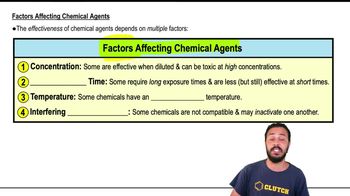
    Diluting some chemical agents can enhance their effectiveness and reduce toxicity.
  • Why is exposure time important when using chemical agents to control microbes?

    Some chemicals require longer exposure times to be effective, so the duration of exposure can greatly affect their efficacy.
  • How does temperature influence the effectiveness of chemical agents?

    Some chemicals have an optimal temperature at which they work best, and temperatures that are too high or too low can reduce their effectiveness.
  • What are interfering chemicals and how do they affect chemical agents?

    Interfering chemicals can react with chemical agents, potentially inactivating them and reducing their effectiveness.
  • List two surfactants mentioned as liquid chemical agents.

    Soaps and detergents are two surfactants used as liquid chemical agents.
  • What is the main difference between a disinfecting and a sterilization procedure in terms of chemical concentration?

    The concentration of the chemical agent can differentiate a disinfecting procedure from a sterilization procedure.
  • What is the role of heavy metals in microbial control?

    Heavy metals are used as liquid chemical agents to control microbial growth.
  • Why must scientists consider interfering chemicals when choosing a chemical agent?

    Because interfering chemicals may react with and inactivate the chosen chemical agent, reducing its effectiveness.
  • What are phenolics and peroxygens classified as in microbial control?

    Phenolics and peroxygens are classified as liquid chemical agents.
  • How do chemical agents inactivate microbial molecules?

    They irreversibly react with proteins, DNA, or plasma membranes, preventing these molecules from functioning normally.
  • Why is it important to use the correct concentration of a chemical agent?

    Using the correct concentration ensures effectiveness while minimizing toxicity and differentiating between disinfection and sterilization.