Back

Characteristics of Infectious Disease quiz #1

Control buttons has been changed to "navigation" mode.
1/11
  • What are the characteristic signs and symptoms of infectious mononucleosis?

    Infectious mononucleosis is characterized by signs and symptoms such as fever, sore throat, and swollen lymph nodes, which are observable and measurable indicators of infection.
  • What is not a normal portal of exit for an infectious disease?

    A portal of exit is a route by which pathogens leave the host; examples include respiratory tract, gastrointestinal tract, and skin. The placenta is not a normal portal of exit for most infectious diseases.
  • What can be considered a reservoir for infectious diseases?

    A reservoir for infectious diseases can be humans, animals, or environmental sources where pathogens can survive and potentially infect new hosts.
  • Which sequence accurately describes the terminology used related to stages of an infectious disease?

    The stages of an infectious disease typically include incubation period, prodromal period, illness, decline, and convalescence.
  • How do infectious diseases develop within a host?

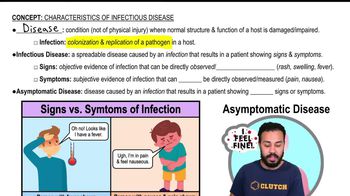
    Infectious diseases develop when a pathogen colonizes and replicates within a host, leading to observable signs and subjective symptoms.
  • What is not a sign of infection?

    Pain is not a sign of infection; it is a symptom, as it is subjective and only experienced by the patient.
  • Diseases caused by pathogens are ____________ diseases.

    Diseases caused by pathogens are infectious diseases.
  • What is not a normal portal of exit for most infectious diseases?

    The placenta is not a normal portal of exit for most infectious diseases.
  • If an individual is a carrier of an infectious disease, he is __________.

    If an individual is a carrier of an infectious disease, he is asymptomatic but can still transmit the pathogen to others.
  • An infectious disease is most accurately defined as:

    An infectious disease is a spreadable disease caused by infection with a pathogen, resulting in signs and symptoms in the host.
  • An infectious disease is most accurately defined as:

    An infectious disease is a condition caused by colonization and replication of a pathogen within a host, leading to observable signs and/or subjective symptoms.