Back

Characteristics of Infectious Disease definitions

Control buttons has been changed to "navigation" mode.
1/15
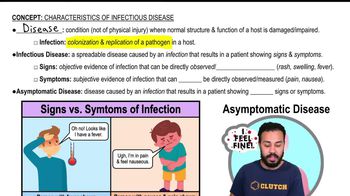
  • Infectious Disease

    A spreadable condition caused by pathogen colonization and replication, resulting in observable signs and subjective symptoms.
  • Pathogen

    A disease-causing agent capable of colonizing and replicating within a host, leading to infection.
  • Sign

    Objective evidence of infection, such as fever or rash, that can be observed or measured by others.
  • Symptom

    Subjective evidence of infection, like pain or nausea, only experienced by the affected individual.
  • Asymptomatic Disease

    A condition where infection is present but no observable signs or subjective symptoms are shown, yet transmission is possible.
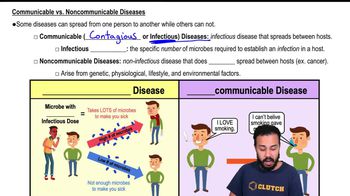
  • Communicable Disease

    A condition that can spread from one host to another, often requiring a specific infectious dose to establish infection.
  • Noncommunicable Disease

    A condition that does not spread between individuals and often arises from genetic, lifestyle, or environmental factors.
  • Infectious Dose

    The minimum number of microbes required to establish infection in a host, influencing disease spread.
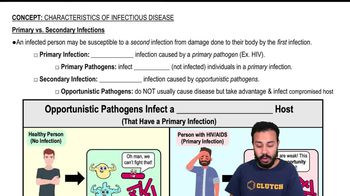
  • Primary Infection

    The initial infection in a host, often caused by a primary pathogen, which can weaken the immune system.
  • Secondary Infection

    A subsequent infection occurring after a primary infection, typically caused by opportunistic pathogens.
  • Primary Pathogen

    An organism capable of causing disease in healthy individuals, initiating the first infection.
  • Opportunistic Pathogen

    An organism that exploits weakened immune defenses to cause disease, usually after a primary infection.
  • Virulence

    The degree of pathogenicity, indicating how likely an organism is to cause disease and the severity of that disease.
  • Virulence Factor

    A specific trait, such as a gene for toxin production, that enhances an organism's ability to cause disease.
  • Immune System

    The host's defense network, including cells like B cells and T cells, that protects against pathogens and infections.