Back

Bacteriophage: Filamentous Phage Infections quiz

Control buttons has been changed to "navigation" mode.
1/15
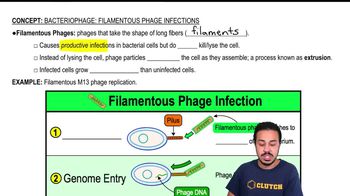
  • What shape are filamentous phages, and where does their name come from?

    Filamentous phages are long, fiber-shaped viruses, and their name comes from their filament-like appearance.
  • Do filamentous phages cause productive or latent infections in bacterial cells?

    Filamentous phages cause productive infections, meaning they actively generate new phages.
  • How do filamentous phages exit the host cell?

    They exit the host cell through a process called extrusion, which does not lyse the cell.
  • Does infection by filamentous phages kill the host cell?

    No, filamentous phage infection does not kill or lyse the host cell.
  • How does the growth rate of a cell infected by filamentous phages compare to an uninfected cell?

    Infected cells grow slower than uninfected cells.
  • What is the first step in the filamentous phage infection process?

    The first step is attachment, where the phage binds to the pilus of the host bacterium.
  • Through what structure does the filamentous phage attach to the host bacterium?

    It attaches to the pilus of the host bacterium.
  • How does the phage genome enter the host cell?

    The phage genome enters the host cell through the pilus.
  • What happens during the synthesis step of filamentous phage infection?

    The phage genome is replicated and phage proteins are synthesized inside the host cell.
  • What is the process called when new filamentous phages are released from the host cell?

    The process is called extrusion.
  • Does the host cell die during the release of filamentous phages?

    No, the host cell remains alive and continues to produce new phages.
  • What is an example of a filamentous phage mentioned in the lesson?

    An example is the M13 phage.
  • What are the four main steps of filamentous phage infection?

    The four steps are attachment, genome entry, synthesis, and release.
  • What accumulates inside the host cell during the synthesis step?

    Phage DNA and viral capsid proteins accumulate inside the host cell.
  • Why are filamentous phages considered harmful even though they do not lyse the host cell?

    They slow down the growth of the infected cell, making them harmful despite not causing cell lysis.