Back

Bacteriophage: Filamentous Phage Infections definitions

Control buttons has been changed to "navigation" mode.
1/13
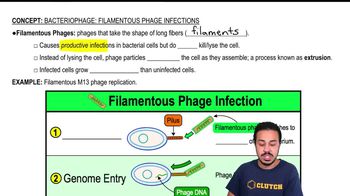
  • Filamentous Phage

    A long, fiber-shaped virus that infects bacteria, producing new viral particles without destroying the host cell.
  • Productive Infection

    A process where new viral particles are continuously generated within a host cell, allowing ongoing virus release.
  • Extrusion

    A mechanism by which new viral particles exit a host cell without causing cell lysis, enabling cell survival.
  • Pilus

    A bacterial surface structure that serves as the specific attachment site for certain viruses during infection.
  • Genome Entry

    The step where viral genetic material passes into a host cell, often through a specialized surface structure.
  • Synthesis

    The stage in viral infection where both viral genetic material and proteins are produced inside the host cell.
  • Capsid Protein

    A structural component that forms the protective outer shell of a virus, assembled during infection.
  • Replication

    The process by which viral genetic material is duplicated within a host cell to produce new viral genomes.
  • M13 Phage

    A well-studied example of a long, filamentous virus that infects bacteria without causing cell death.
  • Host Bacterium

    A bacterial cell that provides the environment and resources necessary for viral infection and reproduction.
  • Phage Protein

    A molecule produced during infection that contributes to the structure or function of new viral particles.
  • Release

    The stage where newly formed viral particles exit the host cell, often occurring simultaneously with assembly.
  • Lysis

    A process absent in filamentous phage infections, where a host cell is destroyed to release viral particles.