Skip to main content
Microbiology
My Course
Learn
Exam Prep
AI Tutor
Study Guides
Textbook Solutions
Flashcards
Explore
Try the app
My Course
Learn
Exam Prep
AI Tutor
Study Guides
Textbook Solutions
Flashcards
Explore
Try the app
Back
Atoms- Smallest Unit of Matter quiz
You can tap to flip the card.
What is the smallest unit of matter?
You can tap to flip the card.
👆
What is the smallest unit of matter?
The atom is the smallest unit of matter, making up both living and nonliving things.
Track progress
Control buttons has been changed to "navigation" mode.
1/15
Related flashcards
Related practice
Recommended videos
Atoms- Smallest Unit of Matter definitions
Atoms- Smallest Unit of Matter
17 Terms
Atoms- Smallest Unit of Matter 
3. Chemical Principles of Microbiology
7 problems
Topic
Brendan
Isotopes
3. Chemical Principles of Microbiology
4 problems
Topic
Brendan
3. Chemical Principles of Microbiology
7 topics
12 problems
Chapter
Nicole
02:13
Atoms- Smallest Unit of Matter Example 1
204
views
03:51
Atoms- Smallest Unit of Matter Example 3
19
views
09:44
Electron Orbitals & Energy Shells
20
views
Terms in this set (15)
Hide definitions
What is the smallest unit of matter?
The atom is the smallest unit of matter, making up both living and nonliving things.
What are the three subatomic particles that make up an atom?
The three subatomic particles are protons, neutrons, and electrons.
Where are protons and neutrons located within an atom?
Protons and neutrons are located in the nucleus at the center of the atom.
What is the charge of an electron?
An electron has a negative charge.
What does the atomic number of an element represent?
The atomic number is the total number of protons in the nucleus of an atom and defines the element.
How is the mass number of an atom calculated?
The mass number is the sum of protons and neutrons in the nucleus of a single atom.
What is the atomic mass (or atomic weight) of an element?
Atomic mass is the average total mass of all atoms of an element, taking into account isotopes.
Which six elements make up about 97% of the mass of most living organisms?
Carbon, hydrogen, nitrogen, oxygen, phosphorus, and sulfur (CHNOPS) make up most of the mass of living organisms.
What are trace elements?
Trace elements are elements required for life in very small amounts.
What are electron orbitals and how are they often represented in biology?
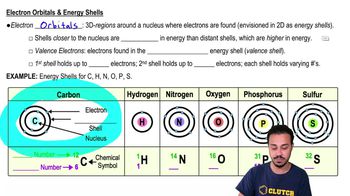
Electron orbitals are 3D regions around the nucleus where electrons are likely found, but are often represented as 2D energy shells.
What is a valence shell?
The valence shell is the outermost energy shell of an atom, containing the valence electrons involved in chemical bonding.
How many electrons can the first and second energy shells hold?
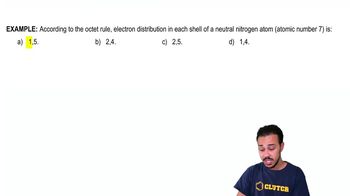
The first energy shell can hold up to 2 electrons, and the second shell can hold up to 8 electrons.
What does the octet rule state?
The octet rule states that atoms are more stable and less reactive when their valence shells are fully occupied, usually with 8 electrons.
What happens to an atom if the number of protons in its nucleus changes?
If the number of protons changes, the atom becomes a different element.
Why are valence electrons important?
Valence electrons are important because they are involved in chemical bonding and determine an atom's reactivity.
 BackBack
 02:13
02:13