Back

Antifungal Drugs quiz

Control buttons has been changed to "navigation" mode.
1/15
  • What is the main challenge in achieving selective toxicity with antifungal drugs?

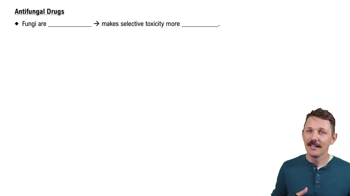
    Fungi are eukaryotes like humans, so their cellular structures are similar, making selective toxicity more difficult.
  • What sterol do fungal cell membranes contain that is targeted by antifungal drugs?

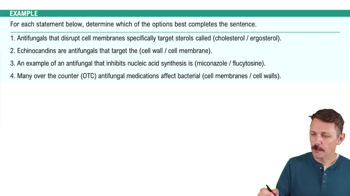
    Fungal cell membranes contain ergosterol, which is targeted by several antifungal drugs.
  • How do azole antifungal drugs work?

    Azoles inhibit the synthesis of ergosterol, destabilizing fungal cell membranes.
  • Name two common azole drugs and their typical uses.

    Clotrimazole is used for skin infections like athlete's foot, and miconazole is used for vaginal yeast infections.
  • What is the mechanism of action of allylamines such as terbinafine (Lamasil)?

    Allylamines inhibit ergosterol synthesis, disrupting fungal cell membrane stability.
  • How do polyene antifungal drugs like nystatin and amphotericin B function?

    Polyenes bind to ergosterol in fungal membranes, causing membrane disruption and cell death.
  • For what type of infections is amphotericin B typically used?

    Amphotericin B is used for severe systemic fungal infections and is administered intravenously.
  • What component of the fungal cell wall is targeted by echinocandins?

    Echinocandins inhibit the synthesis of beta glucan, a key component of the fungal cell wall.
  • What is the result of inhibiting beta glucan synthesis in fungi?

    Inhibiting beta glucan synthesis weakens the cell wall, leading to cell lysis and fungal death.
  • How does flucytosine achieve selective toxicity against fungi?

    Flucytosine is converted by fungal enzymes into a cytosine analog that disrupts nucleic acid synthesis; humans lack this enzyme.
  • What is the primary mechanism of action of flucytosine?

    Flucytosine disrupts DNA and RNA synthesis by acting as a cytosine analog after fungal-specific conversion.
  • Why is flucytosine often used in combination with amphotericin B?

    Flucytosine is used with amphotericin B to treat serious fungal infections, enhancing efficacy.
  • How does griseofulvin inhibit fungal growth?

    Griseofulvin inhibits microtubule assembly, preventing fungal cell division.
  • Why does griseofulvin concentrate in skin, hair, and nails?

    Griseofulvin binds to keratin, which is abundant in skin, hair, and nails, leading to high drug concentrations in these tissues.
  • What types of fungal infections are best treated with griseofulvin?

    Griseofulvin is used for infections of the skin, hair, and nails, such as fungal nail infections.