Back

Animal Viruses: DNA Virus Synthesis & Replication quiz

Control buttons has been changed to "navigation" mode.
1/15
  • Where do most DNA viruses replicate within the host cell?

    Most DNA viruses replicate in the host cell's cytoplasm.
  • What enzyme do most DNA viruses encode to replicate their genome?

    Most DNA viruses encode their own viral DNA polymerase.
  • Why can DNA viruses replicate even when the host cell is not dividing?

    Because they encode their own viral DNA polymerase, allowing replication independent of the host cell's replication cycle.
  • What is the central dogma of biology that dsDNA viruses follow?

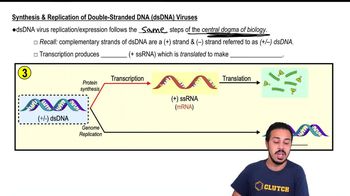
    The central dogma is DNA to mRNA (transcription) to protein (translation).
  • What are the two strands of a double stranded DNA virus called?

    They are called the plus (coding) strand and the minus (template) strand.
  • What is produced from dsDNA during transcription in DNA virus replication?

    Messenger RNA (mRNA), which is also called plus ssRNA, is produced.
  • What is the role of mRNA in DNA virus replication?

    mRNA is translated to produce viral proteins, including viral enzymes.
  • What is the ultimate result of dsDNA virus replication?

    The original viral genome is replicated and viral proteins are synthesized.
  • What additional step is required for ssDNA virus replication compared to dsDNA viruses?

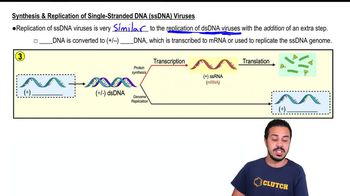
    ssDNA must first be converted into dsDNA before following the typical replication pathway.
  • After ssDNA is converted to dsDNA, what processes occur next?

    The dsDNA is transcribed to mRNA and then translated to make viral proteins, just like dsDNA viruses.
  • How is the original ssDNA genome regenerated during replication?

    The dsDNA intermediate is used as a template to replicate the original ssDNA genome.
  • What happens after viral proteins and genomes are synthesized in DNA virus replication?

    The components are assembled into new viral particles, which is the next stage of infection.
  • Can ssDNA viruses have either a plus or minus strand as their genome?

    Yes, ssDNA viruses can have either a plus (coding) or minus (template) strand.
  • What does the term 'plus ssRNA' refer to in the context of DNA virus replication?

    It refers to messenger RNA (mRNA) that encodes the genetic message for protein synthesis.
  • What is the main similarity between dsDNA and ssDNA virus replication after the dsDNA intermediate is formed?

    Both use dsDNA as a template for transcription and translation to produce viral proteins and replicate the genome.