
Textbook Question
Compare and contrast the following aspects of endotoxins and exotoxins: bacterial source, chemistry, toxigenicity, and pharmacology. Give an example of each toxin.
4
views

 Verified step by step guidance
 05:09
05:09
 03:05
03:05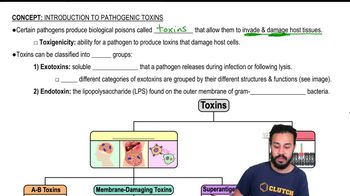 03:40
03:40Compare and contrast the following aspects of endotoxins and exotoxins: bacterial source, chemistry, toxigenicity, and pharmacology. Give an example of each toxin.
Label this diagram to show how the Shiga toxin enters and inhibits protein synthesis in a human cell.
Explain how drugs that bind each of the following would affect pathogenicity:
a. Iron in the host's blood
b. N. gonorrhoeae fimbriae
c. S. pyogenes M protein
A drug that binds to mannose on human cells would prevent
a. the entrance of Vibrio enterotoxin.
b. the attachment of pathogenic E. coli.
c. the action of botulinum toxin.
d. streptococcal pneumonia.
e. the action of diphtheria toxin.
Describe the factors contributing to the pathogenicity of fungi, protozoa, and helminths.
All of the following are related to bacterial infection. Which would prevent all of the others?
a. Vaccination against fimbriae
b. Phagocytosis
c. Inhibition of phagocytic digestion
d. Destruction of adhesins
e. Alteration of cytoskeleton