Ch. 1 - Introduction to Microbiology
Norman-McKay- Microbiology: Basic and Clinical Principles 2nd Edition
Norman-McKay2nd EditionMicrobiology: Basic and Clinical PrinciplesISBN: 9780137661619Not the one you use?Change textbook
Chapter 1, Problem 19

Over time, Koch’s disease postulates have been rephrased in a variety of ways, but they still reflect the same process outlined by Robert Koch. The following are reworded versions of Koch’s postulates. Based on the original postulates, put the following items in the correct order.
a. Use the purified agent to cause infection in a test animal.
b. Isolate an infectious agent from a diseased animal.
c. Grow the infectious agent as a pure culture in the lab.
d. From the test animal, re-isolate the infectious agent that was originally grown in pure culture.

Verified step by step guidance
1
Step 1: Understand that Koch's postulates are a sequence of steps designed to establish a causative relationship between a microbe and a disease.
Step 2: The first step is to isolate the infectious agent from a diseased animal, which corresponds to item b.
Step 3: Next, grow the isolated infectious agent as a pure culture in the laboratory, which corresponds to item c.
Step 4: Then, use the purified agent from the pure culture to cause infection in a healthy test animal, which corresponds to item a.
Step 5: Finally, re-isolate the infectious agent from the newly infected test animal to confirm it is the same as the original, which corresponds to item d.

Verified video answer for a similar problem:

This video solution was recommended by our tutors as helpful for the problem above.
Video duration:
4m
Was this helpful?

Key Concepts

Here are the essential concepts you must grasp in order to answer the question correctly.

Koch's Postulates

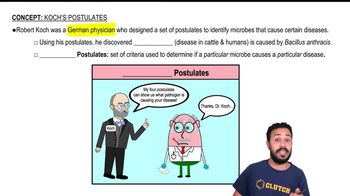
Koch's postulates are a set of criteria established to link a specific microorganism to a particular disease. They provide a systematic method to prove causation by isolating the pathogen, growing it in pure culture, causing disease in a healthy host, and re-isolating the same pathogen. These steps ensure the microorganism is the true cause of the disease.
Recommended video:
Guided course
01:36
Koch's Postulates

Pure Culture Techniques

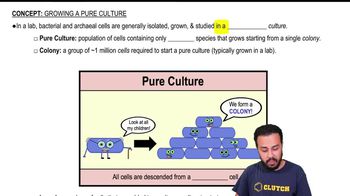
Pure culture techniques involve isolating a single species of microorganism from a mixed sample and growing it in controlled laboratory conditions. This is essential to study the characteristics of the pathogen without interference from other microbes, and to fulfill Koch’s requirement of demonstrating the disease-causing agent in isolation.
Recommended video:
Guided course
02:58
Growing a Pure Culture

Experimental Infection and Re-isolation

Experimental infection involves introducing the isolated pure culture into a healthy test animal to reproduce the disease symptoms. Re-isolation of the same microorganism from the newly diseased host confirms that the agent causes the disease, completing the proof of causation as outlined in Koch’s postulates.
Recommended video:
Guided course
02:50
Experimental Design Example 1