Ch. 1 - Introduction to Microbiology
Norman-McKay- Microbiology: Basic and Clinical Principles 2nd Edition
Norman-McKay2nd EditionMicrobiology: Basic and Clinical PrinciplesISBN: 9780137661619Not the one you use?Change textbook
Chapter 1, Problem 18

Why is it clinically helpful to know the Gram property of an organism?

Verified step by step guidance
1
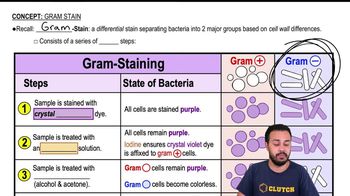
Understand that the Gram property of an organism refers to whether it is Gram-positive or Gram-negative, based on the structure of its cell wall and its reaction to the Gram stain procedure.
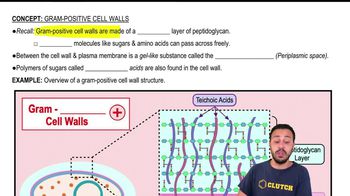
Recognize that Gram-positive bacteria have a thick peptidoglycan layer in their cell walls, which retains the crystal violet stain, appearing purple under a microscope, while Gram-negative bacteria have a thinner peptidoglycan layer and an outer membrane, appearing pink or red after counterstaining.
Know that this distinction is clinically helpful because it guides the choice of antibiotics, as Gram-positive and Gram-negative bacteria often differ in their susceptibility to certain antimicrobial agents.
Realize that knowing the Gram property also helps in predicting the organism's pathogenic mechanisms, potential toxins produced, and typical infection sites, which aids in diagnosis and treatment planning.
Finally, use the Gram property as an initial step in microbial identification in the clinical laboratory, which speeds up the process of determining the causative agent of an infection.

Verified video answer for a similar problem:

This video solution was recommended by our tutors as helpful for the problem above.
Video duration:
3m
Was this helpful?

Key Concepts

Here are the essential concepts you must grasp in order to answer the question correctly.

Gram Staining Technique

Gram staining is a differential staining method that classifies bacteria into Gram-positive or Gram-negative based on their cell wall structure. This technique uses crystal violet and safranin dyes to distinguish bacteria by color, aiding in their identification.
Recommended video:

Differences in Cell Wall Structure

Gram-positive bacteria have thick peptidoglycan layers retaining the crystal violet stain, while Gram-negative bacteria have thinner peptidoglycan and an outer membrane, causing them to appear pink after staining. These structural differences influence bacterial behavior and treatment.
Recommended video:
Guided course
02:59
Gram-Positive Cell Walls

Clinical Implications of Gram Property

Knowing the Gram property helps guide antibiotic selection, as Gram-positive and Gram-negative bacteria respond differently to drugs. It also aids in diagnosis, infection control, and understanding pathogenic mechanisms, making it crucial for effective clinical management.
Recommended video:
Guided course
04:07
Properties of Water- Thermal
Related Practice
Textbook Question

Which of the following is/are true regarding our normal microbiota? Select all that apply.

a. Our normal microbiota is easily disrupted by hygiene practices like hand washing.

b. Our normal microbiota can include pathogens.

c. Normal microbiota compete with pathogens.

d. Normal microbiota may colonize us before we are even born.

e. Normal microbiota changes over time.

f. The normal microbiota that we have as adults is the same as we had as children.

g. The normal microbiota of the gut is similar to that of the skin.

1
views
Textbook Question

Acid-fast bacteria contain ___________________ in their cell wall.

6
views
Textbook Question

List the following taxonomic groupings in order from general to specific.

Phylum, Kingdom, Genus, Family, Class, Domain, Species, Order

Textbook Question

Which of the following is true?

a. SEM is higher resolution than TEM.

b. Most viruses can be seen using a light microscope.

c. Simple staining involves an acidic and a basic dye in combination.

d. Samples can be stained or unstained for light microscopy.

e. These are all false statements.

2
views
Textbook Question

Immersion oil improves resolution by:

a. Limiting light refraction.

b. Magnifying the specimen.

c. Improving specimen contrast.

d. Making light waves shorter.

e. Making light waves faster.

1
views
Textbook Question

Over time, Koch’s disease postulates have been rephrased in a variety of ways, but they still reflect the same process outlined by Robert Koch. The following are reworded versions of Koch’s postulates. Based on the original postulates, put the following items in the correct order.

a. Use the purified agent to cause infection in a test animal.

b. Isolate an infectious agent from a diseased animal.

c. Grow the infectious agent as a pure culture in the lab.

d. From the test animal, re-isolate the infectious agent that was originally grown in pure culture.

1
views