Ch. 3 - Observing Microorganisms Through a Microscope
Tortora - Microbiology: An Introduction 14th Edition
Tortora14th EditionMicrobiology: An IntroductionISBN: 9780138200398Not the one you use?Change textbook
Chapter 3, Problem 4

Calculate the total magnification of the nucleus of a cell being observed through a compound light microscope with a 10x ocular lens and an oil immersion lens.

Verified step by step guidance
1
Identify the magnification of the ocular lens (eyepiece), which is given as 10x in the problem.
Determine the magnification of the objective lens. Since the problem states an oil immersion lens, this typically has a magnification of 100x.
Recall that the total magnification of a compound light microscope is calculated by multiplying the magnification of the ocular lens by the magnification of the objective lens.
Write the formula for total magnification as: \(\text{Total Magnification} = \text{Ocular Magnification} \times \text{Objective Magnification}\).
Substitute the known values into the formula: \(\text{Total Magnification} = 10x \times 100x\) and then multiply to find the total magnification.

Verified video answer for a similar problem:

This video solution was recommended by our tutors as helpful for the problem above.
Video duration:
2m
Was this helpful?

Key Concepts

Here are the essential concepts you must grasp in order to answer the question correctly.

Total Magnification in Microscopy

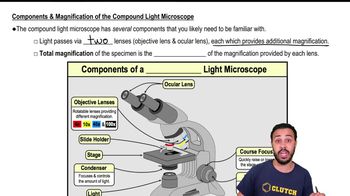
Total magnification is the product of the magnification powers of the ocular (eyepiece) lens and the objective lens. It determines how much larger the specimen appears compared to its actual size. For example, a 10x ocular lens combined with a 100x objective lens results in 1000x total magnification.
Recommended video:
Guided course
06:15
Components & Magnification of the Compound Light Microscope

Ocular Lens (Eyepiece)

The ocular lens is the lens closest to the observer's eye in a compound microscope, typically providing a fixed magnification, often 10x. It further enlarges the image formed by the objective lens, contributing to the overall magnification.
Recommended video:
Guided course
06:15
Components & Magnification of the Compound Light Microscope

Oil Immersion Objective Lens

An oil immersion lens is a high-power objective (usually 100x) used with a special immersion oil to increase resolution and clarity by reducing light refraction. It allows detailed observation of tiny structures like the cell nucleus at very high magnifications.
Recommended video:
Guided course
06:15
Components & Magnification of the Compound Light Microscope
Related Practice
Textbook Question

Why is a mordant used in the Gram stain? In the flagella stain?

Textbook Question

The maximum magnification of a compound microscope is (a) ________; that of an electron microscope, (b) ________. The maximum resolution of a compound microscope is (c) ________; that of an electron microscope, (d) ________. One advantage of a scanning electron microscope over a transmission electron microscope is (e) ________.

2
views
Textbook Question

Looking at the cell of a photosynthetic microorganism, you observe the chloroplasts are green in brightfield microscopy and red in fluorescence microscopy. You conclude:

a. Chlorophyll is fluorescent

b. The magnification has distorted the image

c. You’re not looking at the same structure in both microscopes

d. The stain masked the green color

e. None of the above

1
views
Textbook Question

Which of the following is not a functionally analogous pair of stains?

a. Nigrosin and malachite green

b. Crystal violet and carbolfuchsin

c. Safranin and methylene blue

d. Ethanol-acetone and acid-alcohol

e. All of the above pairs are functionally analogous.

2
views
Textbook Question

Which type of microscope would be best to use to observe each of the following?

a. A stained bacterial smear

b. Unstained bacterial cells: the cells are small, and no detail is needed

c. Unstained live tissue when it is desirable to see some intracellular detail

d. A sample that emits light when illuminated with ultraviolet light

e. Intracellular detail of a cell that is 1μm long

f. Unstained live cells in which intracellular structures are shown in color

1
views
Textbook Question

Carbolfuchsin can be used as a simple stain and a negative stain. As a simple stain, the pH is:

a. 2

b. Higher than the negative stain

c. Lower than the negative stain

d. The same as the negative stain