Ch. 3 - Observing Microorganisms Through a Microscope
Tortora - Microbiology: An Introduction 14th Edition
Tortora14th EditionMicrobiology: An IntroductionISBN: 9780138200398Not the one you use?Change textbook
Chapter 3, Problem 4

Looking at the cell of a photosynthetic microorganism, you observe the chloroplasts are green in brightfield microscopy and red in fluorescence microscopy. You conclude:
a. Chlorophyll is fluorescent
b. The magnification has distorted the image
c. You’re not looking at the same structure in both microscopes
d. The stain masked the green color
e. None of the above

Verified step by step guidance
1
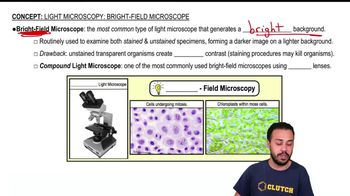
Step 1: Understand the nature of chloroplasts and chlorophyll. Chloroplasts contain chlorophyll, which is a pigment responsible for capturing light energy during photosynthesis and is naturally green in color when observed under brightfield microscopy.
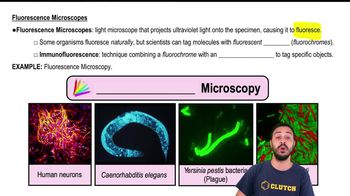
Step 2: Recall the principle of fluorescence microscopy. Fluorescence microscopy detects the emission of light from a substance that has absorbed light or other electromagnetic radiation. Chlorophyll is known to fluoresce, typically emitting red light when excited by certain wavelengths.
Step 3: Compare the observations from both microscopy techniques. Seeing chloroplasts as green in brightfield microscopy aligns with their natural pigment color, while seeing them as red in fluorescence microscopy corresponds to the red fluorescence emitted by chlorophyll.
Step 4: Evaluate the answer choices based on these observations. Since the same structure (chloroplasts) appears green in brightfield and red in fluorescence due to chlorophyll's properties, the correct conclusion is that chlorophyll is fluorescent.
Step 5: Conclude that the correct answer is option (a) chlorophyll is fluorescent, because the color change is due to the fluorescence property of chlorophyll, not due to distortion, different structures, or staining.

Verified video answer for a similar problem:

This video solution was recommended by our tutors as helpful for the problem above.
Video duration:
2m
Was this helpful?

Key Concepts

Here are the essential concepts you must grasp in order to answer the question correctly.

Chlorophyll and its Fluorescence

Chlorophyll is a pigment found in chloroplasts that absorbs light for photosynthesis. It appears green under brightfield microscopy due to its natural color. When exposed to specific wavelengths in fluorescence microscopy, chlorophyll emits red fluorescence, revealing its fluorescent properties.
Recommended video:
Guided course
02:54
Fluorescence Microscopes

Differences Between Brightfield and Fluorescence Microscopy

Brightfield microscopy uses white light to illuminate samples, showing natural colors of structures. Fluorescence microscopy uses specific light wavelengths to excite fluorescent molecules, causing them to emit light at different wavelengths, often revealing features not visible in brightfield.
Recommended video:
Guided course
02:54
Fluorescence Microscopes

Interpretation of Microscopic Images

Understanding that the same cellular structure can appear differently under various microscopy techniques is crucial. Color changes often reflect different imaging principles rather than artifacts or stains, helping to correctly identify structures like chloroplasts in both brightfield and fluorescence images.
Recommended video:
Guided course
03:46
Light Microscopy: Bright-Field Microscopes
Related Practice
Textbook Question

Three-dimensional images of live cells can be produced with:

a. Darkfield microscopy

b. Fluorescence microscopy

c. Transmission electron microscopy

d. Confocal microscopy

e. Phase-contrast microscopy

2
views

Textbook Question

The maximum magnification of a compound microscope is (a) ________; that of an electron microscope, (b) ________. The maximum resolution of a compound microscope is (c) ________; that of an electron microscope, (d) ________. One advantage of a scanning electron microscope over a transmission electron microscope is (e) ________.

2
views
Textbook Question

Which of the following is not a functionally analogous pair of stains?

a. Nigrosin and malachite green

b. Crystal violet and carbolfuchsin

c. Safranin and methylene blue

d. Ethanol-acetone and acid-alcohol

e. All of the above pairs are functionally analogous.

2
views
Textbook Question

Calculate the total magnification of the nucleus of a cell being observed through a compound light microscope with a 10x ocular lens and an oil immersion lens.

3
views
Textbook Question

Which type of microscope would be best to use to observe each of the following?

a. A stained bacterial smear

b. Unstained bacterial cells: the cells are small, and no detail is needed

c. Unstained live tissue when it is desirable to see some intracellular detail

d. A sample that emits light when illuminated with ultraviolet light

e. Intracellular detail of a cell that is 1μm long

f. Unstained live cells in which intracellular structures are shown in color

1
views
Textbook Question

Carbolfuchsin can be used as a simple stain and a negative stain. As a simple stain, the pH is:

a. 2

b. Higher than the negative stain

c. Lower than the negative stain

d. The same as the negative stain