
Textbook Question
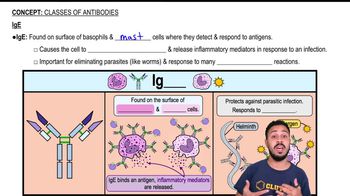
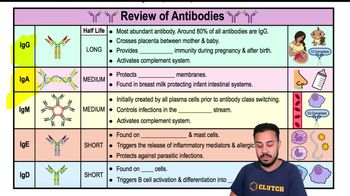
The major inflammatory mediator released by degranulating mast cells in type I hypersensitivity is:
a. Immunoglobulin
b. Complement
c. Histamine
d. Interleukin
e. Prostaglandin
8
views

 Verified step by step guidance
 01:06
01:06
 03:48
03:48The major inflammatory mediator released by degranulating mast cells in type I hypersensitivity is:
a. Immunoglobulin
b. Complement
c. Histamine
d. Interleukin
e. Prostaglandin
Put the number of the type of immune system hypersensitivity in the blank next to each manifestation. Each of the four types may be used more than once or not at all. If the manifestation is not an immune hypersensitivity, put zero in the blank.
1. Acute anaphylaxis
2. Allergic contact dermatitis
3. Systemic lupus erythematosus
4. Allograft rejection
5. AIDS
6. Graft-versus-host disease
7. Milk allergy
8. Rheumatoid arthritis (RA)
9. Asthma
10. Hay fever
I. Type I hypersensitivity
II. Type II hypersensitivity
III. Type III hypersensitivity
IV. Type IV hypersensitivity
0. Not a hypersensitivity
Indicate whether each statement is true or false. If the statement is false, change the underlined word or phrase to make the statement true.
________ Cyclosporine is released by degranulating mast cells.
Indicate whether each statement is true or false. If the statement is false, change the underlined word or phrase to make the statement true.
_____ Type III hypersensitivity reactions may lead to the development of glomerulonephritis.
Why is a child born to an Rh+ mother not susceptible to Rh-related hemolytic disease of the newborn?
Label the four types of grafts on the accompanying figure.