Ch. 18 - Immune Disorders
Bauman - Microbiology with Diseases by Taxonomy 6th Edition
Bauman6th EditionMicrobiology with Diseases by TaxonomyISBN: 9780134832302Not the one you use?Change textbook
Chapter 18, Problem 1

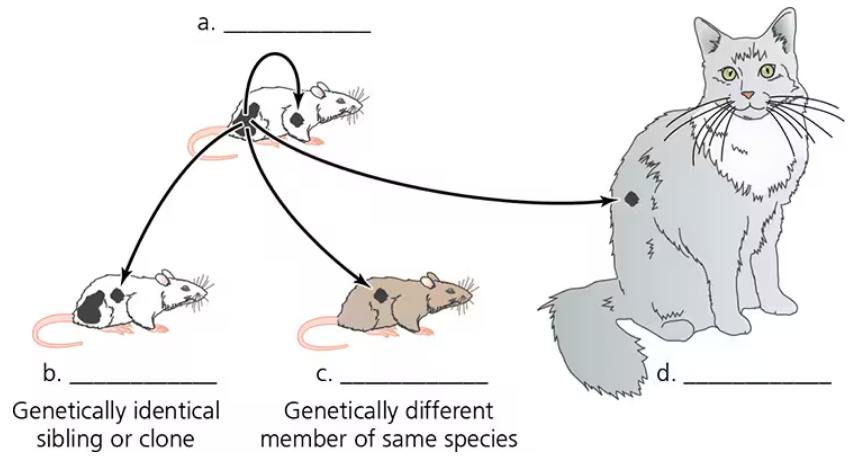
Label the four types of grafts on the accompanying figure.
Diagram showing four types of grafts with arrows between donor and recipient mice and a cat, indicating genetic similarity levels.

Verified step by step guidance
1
Understand the four types of grafts commonly studied in immunology and microbiology: autograft, isograft, allograft, and xenograft.
Identify an autograft as a graft transplanted from one site to another on the same individual, meaning the donor and recipient are the same person.
Recognize an isograft as a graft between genetically identical individuals, such as identical twins, where the tissue is genetically identical.
Label an allograft as a graft between genetically different members of the same species, which is the most common type of transplant and often requires immunosuppression.
Identify a xenograft as a graft between members of different species, such as transplanting a pig heart valve into a human, which typically has the highest risk of rejection.

Verified video answer for a similar problem:

This video solution was recommended by our tutors as helpful for the problem above.
Video duration:
2m
Was this helpful?

Key Concepts

Here are the essential concepts you must grasp in order to answer the question correctly.

Types of Tissue Grafts

Tissue grafts are classified based on the genetic relationship between donor and recipient. The four main types are autografts (from the same individual), isografts (between genetically identical individuals), allografts (between genetically different individuals of the same species), and xenografts (between different species). Understanding these distinctions is crucial for identifying graft types in clinical or experimental contexts.
Recommended video:
Guided course
01:06
Types of Phosphorylation

Immune Response to Grafts

The recipient's immune system can recognize grafts as foreign, leading to rejection. Autografts usually avoid rejection, while allografts and xenografts often trigger immune responses due to antigen differences. Knowledge of immune compatibility helps explain graft survival and the need for immunosuppressive therapies.
Recommended video:
Guided course
02:57
Intro to Immune Response Damage

Clinical Applications and Challenges of Grafting

Grafting is widely used in surgery and transplantation to repair or replace damaged tissues. Each graft type has specific clinical uses and challenges, such as availability, rejection risk, and ethical considerations. Recognizing these factors aids in understanding the practical implications of graft selection.
Recommended video:
Guided course
03:07
Review & Application of DNA Cloning in Medicine
Related Practice
Textbook Question

Why is AIDS more accurately termed a syndrome rather than a mere disease?

1
views

Textbook Question

The major inflammatory mediator released by degranulating mast cells in type I hypersensitivity is:

a. Immunoglobulin

b. Complement

c. Histamine

d. Interleukin

e. Prostaglandin

8
views
Textbook Question

Put the number of the type of immune system hypersensitivity in the blank next to each manifestation. Each of the four types may be used more than once or not at all. If the manifestation is not an immune hypersensitivity, put zero in the blank.

1. Acute anaphylaxis

2. Allergic contact dermatitis

3. Systemic lupus erythematosus

4. Allograft rejection

5. AIDS

6. Graft-versus-host disease

7. Milk allergy

8. Rheumatoid arthritis (RA)

9. Asthma

10. Hay fever

I. Type I hypersensitivity

II. Type II hypersensitivity

III. Type III hypersensitivity

IV. Type IV hypersensitivity

0. Not a hypersensitivity

2
views
Textbook Question

Indicate whether each statement is true or false. If the statement is false, change the underlined word or phrase to make the statement true.

________ Cyclosporine is released by degranulating mast cells.

1
views
Textbook Question

Indicate whether each statement is true or false. If the statement is false, change the underlined word or phrase to make the statement true.

_____ Type III hypersensitivity reactions may lead to the development of glomerulonephritis.

5
views
Textbook Question

The immunoglobulin class that mediates type I hypersensitivity is:

a. IgA

b. IgM

c. IgG

d. IgD

e. IgE

2
views