Ch. 8 - Microbial Genetics
Tortora - Microbiology: An Introduction 14th Edition
Tortora14th EditionMicrobiology: An IntroductionISBN: 9780138200398Not the one you use?Change textbook
Chapter 8, Problem 2

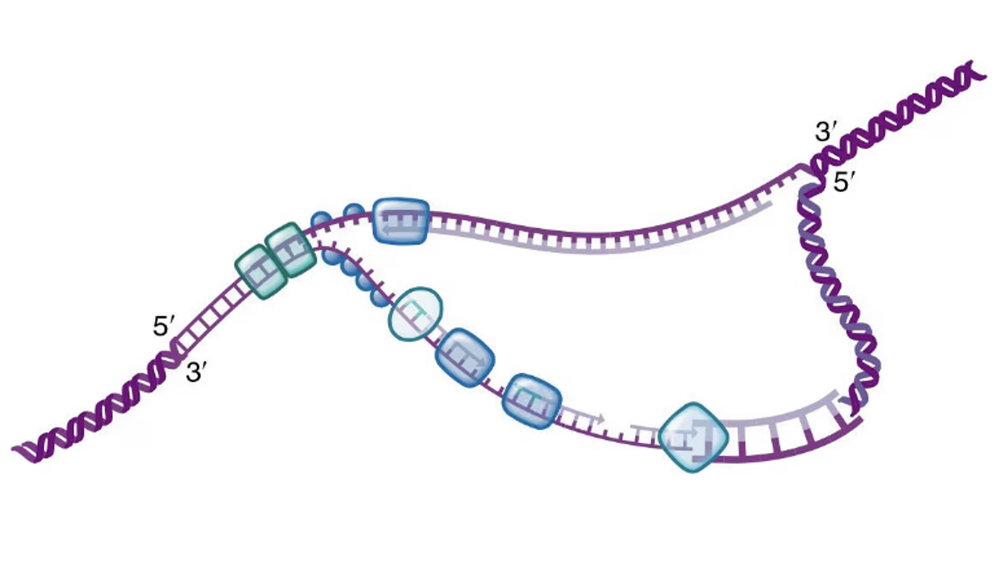
Identify and mark each of the following on the portion of DNA undergoing replication: replication fork, DNA polymerase, RNA primer, parent strands, leading strand, lagging strand, the direction of replication on each strand, and the 5′ end of each strand.
DNA replication diagram showing replication fork, DNA polymerase, RNA primer, parent strands, leading and lagging strands, and 5′ ends.

Verified step by step guidance
1
Begin by identifying the two parent DNA strands. These are the original strands of the double helix that are being separated during replication. Mark them clearly as 'parent strands'.
Locate the replication fork, which is the Y-shaped region where the DNA double helix is unwound to allow replication. This is the point where the two parent strands separate.
Next, identify the direction of replication on each strand. DNA synthesis always occurs in the 5′ to 3′ direction. Determine the 5′ and 3′ ends of each parent strand to understand the direction in which new strands are synthesized.
Mark the leading strand on each side of the fork. The leading strand is synthesized continuously in the same direction as the replication fork movement, following the 5′ to 3′ direction.
Identify the lagging strand, which is synthesized discontinuously in short fragments called Okazaki fragments, opposite to the direction of the replication fork movement. Mark the RNA primers on the lagging strand, as these primers provide the starting point for DNA polymerase to begin synthesis.

Verified video answer for a similar problem:

This video solution was recommended by our tutors as helpful for the problem above.
Video duration:
2m
Was this helpful?

Key Concepts

Here are the essential concepts you must grasp in order to answer the question correctly.

DNA Replication Fork

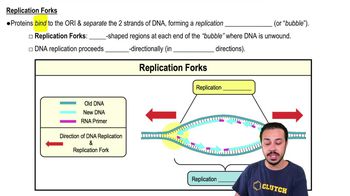
The replication fork is the Y-shaped region where the double-stranded DNA is unwound into two single strands to allow replication. It is the active site of DNA synthesis, with helicase separating the parent strands and creating two template strands for copying.
Recommended video:
Guided course
04:00
Replication Forks

Leading and Lagging Strands

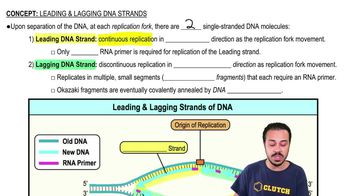
During replication, the leading strand is synthesized continuously in the 5′ to 3′ direction toward the replication fork, while the lagging strand is synthesized discontinuously away from the fork in short fragments called Okazaki fragments. This difference arises because DNA polymerase can only add nucleotides in the 5′ to 3′ direction.
Recommended video:
Guided course
05:15
Leading & Lagging DNA Strands

Role of RNA Primer and DNA Polymerase

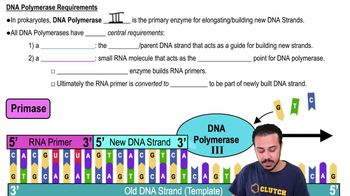
RNA primers are short RNA sequences synthesized by primase that provide a starting point for DNA polymerase to begin DNA synthesis. DNA polymerase extends the primer by adding nucleotides complementary to the template strand, ensuring accurate replication of the DNA.
Recommended video:
Guided course
05:03
DNA Polymerases Requirements