Ch. 9 - Biotechnology & DNA Technology
Tortora - Microbiology: An Introduction 14th Edition
Tortora14th EditionMicrobiology: An IntroductionISBN: 9780138200398Not the one you use?Change textbook
Chapter 9, Problem 8

You are attempting to insert a gene for saltwater tolerance into a plant by using the Ti plasmid. In addition to the desired gene, you add a gene for tetracycline resistance (tet) to the plasmid. What is the purpose of the tet gene?

Verified step by step guidance
1
Understand that the Ti plasmid is used as a vector to transfer genes into plant cells, allowing for genetic modification.
Recognize that the tetracycline resistance (tet) gene is commonly used as a selectable marker in genetic engineering.
The purpose of the tet gene is to allow researchers to identify and select only those plant cells that have successfully incorporated the Ti plasmid with the desired gene.
This selection is done by growing the transformed cells on a medium containing tetracycline; only cells with the tet gene will survive.
Thus, the tet gene helps distinguish transformed cells from non-transformed ones, ensuring that further analysis or cultivation is done on genetically modified plants.

Verified video answer for a similar problem:

This video solution was recommended by our tutors as helpful for the problem above.
Video duration:
1m
Was this helpful?

Key Concepts

Here are the essential concepts you must grasp in order to answer the question correctly.

Ti Plasmid and Genetic Engineering

The Ti plasmid is a natural vector from Agrobacterium tumefaciens used to transfer genes into plants. It enables the insertion of desired genes, such as saltwater tolerance, into the plant genome, facilitating genetic modification for improved traits.
Recommended video:

Selectable Marker Genes

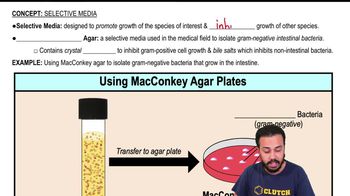
Selectable marker genes, like tetracycline resistance (tet), are added to plasmids to identify and select successfully transformed cells. Only cells that incorporate the plasmid survive in the presence of the antibiotic, allowing researchers to isolate genetically modified plants.
Recommended video:
Guided course
03:27
Selective Media

Antibiotic Resistance in Molecular Cloning

Antibiotic resistance genes provide a survival advantage under antibiotic exposure, serving as a tool to confirm gene insertion. In this case, the tet gene allows researchers to apply tetracycline to kill non-transformed cells, ensuring only those with the plasmid grow.
Recommended video:
Guided course
03:20
The 3 Molecular Koch's Postulates