Ch. 2 - Biochemistry Basics
Norman-McKay- Microbiology: Basic and Clinical Principles 2nd Edition
Norman-McKay2nd EditionMicrobiology: Basic and Clinical PrinciplesISBN: 9780137661619Not the one you use?Change textbook
Chapter 2, Problem 11

The notation 18O denotes a(n)
a. Isomer.
b. Isotope.
c. Dipole.
d. Ion.
e. Reaction.

Verified step by step guidance
1
Understand that the notation 18 O refers to an element of oxygen with a specific number associated with it.
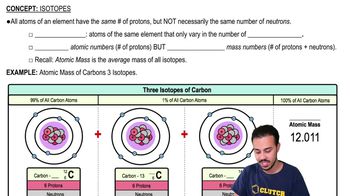
Recall that isotopes are atoms of the same element that have the same number of protons but different numbers of neutrons, resulting in different mass numbers.
Recognize that the number 18 in 18 O represents the mass number, which is the sum of protons and neutrons in the nucleus of the oxygen atom.
Compare this to the common oxygen isotope, which has a mass number of 16 (8 protons and 8 neutrons), so 18 O has 8 protons and 10 neutrons.
Conclude that 18 O is an isotope of oxygen, as it differs in neutron number but is the same element.

Verified video answer for a similar problem:

This video solution was recommended by our tutors as helpful for the problem above.
Video duration:
1m
Was this helpful?

Key Concepts

Here are the essential concepts you must grasp in order to answer the question correctly.

Isotopes

Isotopes are variants of a chemical element that have the same number of protons but different numbers of neutrons, resulting in different atomic masses. For example, oxygen-18 (18O) has 8 protons and 10 neutrons, unlike the most common oxygen-16 isotope with 8 neutrons.
Recommended video:

Isomers

Isomers are molecules with the same molecular formula but different structural arrangements or spatial orientations. This concept applies mainly to organic compounds and does not relate to atomic notation like 18O.

Ions

Ions are atoms or molecules that have gained or lost electrons, resulting in a net electrical charge. The notation 18O does not indicate a charge, so it is not an ion.
Recommended video: