Ch. 2 - Biochemistry Basics
Norman-McKay- Microbiology: Basic and Clinical Principles 2nd Edition
Norman-McKay2nd EditionMicrobiology: Basic and Clinical PrinciplesISBN: 9780137661619Not the one you use?Change textbook
Chapter 2, Problem 9

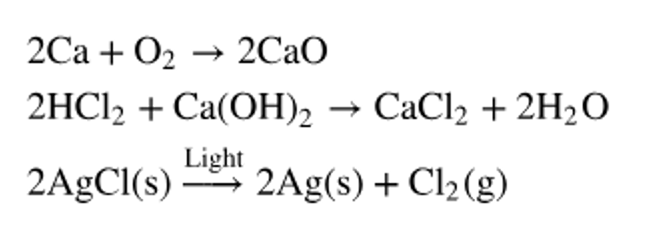
In each of the following reactions, identify the products and reactants, and state what class of reaction is shown.

Verified step by step guidance
1
Step 1: Carefully observe the given chemical reaction to identify the substances on the left side of the reaction arrow as reactants and those on the right side as products.
Step 2: Write down the names or formulas of the reactants and products separately to clearly distinguish them.
Step 3: Analyze the changes occurring from reactants to products, such as bond formation or breaking, addition or removal of atoms or groups, or rearrangement of molecules.
Step 4: Based on the observed changes, classify the reaction into one of the common classes in microbiology-related chemistry, such as hydrolysis, condensation, oxidation-reduction, substitution, or polymerization.
Step 5: Summarize your findings by stating the reactants, products, and the class of reaction, explaining briefly why the reaction fits that category.

Verified video answer for a similar problem:

This video solution was recommended by our tutors as helpful for the problem above.
Video duration:
1m
Was this helpful?

Key Concepts

Here are the essential concepts you must grasp in order to answer the question correctly.

Reactants and Products in Chemical Reactions

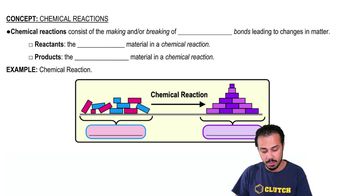
Reactants are the starting substances in a chemical reaction, while products are the substances formed as a result. Identifying these components is essential to understand the direction and outcome of the reaction.
Recommended video:
Guided course
01:56
Chemical Reactions

Classification of Chemical Reactions

Chemical reactions are categorized into classes such as synthesis, decomposition, single replacement, double replacement, and combustion. Recognizing the type helps predict reaction behavior and products.
Recommended video:
Guided course
01:56
Chemical Reactions

Balancing Chemical Equations

Balancing ensures the law of conservation of mass is followed by having equal numbers of each atom on both sides of the equation. This is crucial for accurately representing the reaction and understanding stoichiometry.
Recommended video:
Guided course
01:56
Chemical Reactions