Ch. 5 - Microbial Metabolism
Bauman - Microbiology with Diseases by Taxonomy 6th Edition
Bauman6th EditionMicrobiology with Diseases by TaxonomyISBN: 9780134832302Not the one you use?Change textbook
Chapter 5, Problem 3

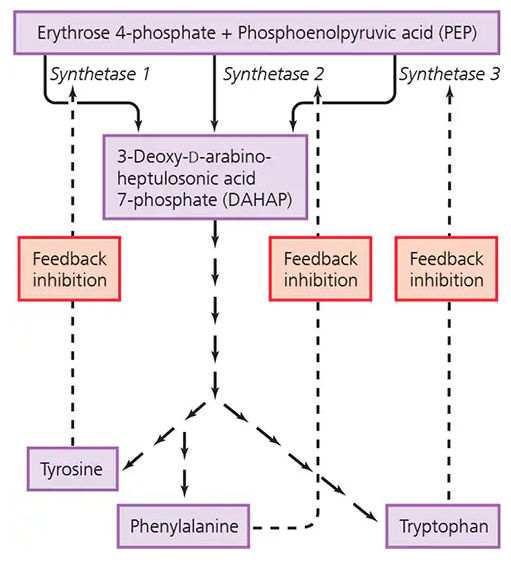
Examine the biosynthetic pathway for the production of the amino acids tryptophan, tyrosine, and phenylalanine in the figure. Where do the initial reactants (erythrose 4-phosphate and PEP) originate?
Diagram showing erythrose 4-phosphate and PEP forming DAHAP, leading to tyrosine, phenylalanine, and tryptophan with feedback inhibition.

Verified step by step guidance
1
Step 1: Identify the initial reactants in the biosynthetic pathway. According to the diagram, the pathway begins with erythrose 4-phosphate and phosphoenolpyruvic acid (PEP).
Step 2: Understand the metabolic origin of erythrose 4-phosphate. Erythrose 4-phosphate is an intermediate of the pentose phosphate pathway, which is a metabolic pathway parallel to glycolysis that generates NADPH and pentoses.
Step 3: Understand the metabolic origin of phosphoenolpyruvic acid (PEP). PEP is an intermediate in glycolysis, the central pathway for glucose catabolism, where it is formed from 2-phosphoglycerate and then converted to pyruvate.
Step 4: Recognize that these two molecules (erythrose 4-phosphate from the pentose phosphate pathway and PEP from glycolysis) combine to form 3-deoxy-D-arabino-heptulosonic acid 7-phosphate (DAHAP), the first committed step in the biosynthesis of aromatic amino acids.
Step 5: Conclude that the initial reactants originate from two distinct but interconnected metabolic pathways: erythrose 4-phosphate from the pentose phosphate pathway and PEP from glycolysis, linking central carbon metabolism to amino acid biosynthesis.

Verified video answer for a similar problem:

This video solution was recommended by our tutors as helpful for the problem above.
Video duration:
2m
Was this helpful?

Key Concepts

Here are the essential concepts you must grasp in order to answer the question correctly.

Origin of Erythrose 4-Phosphate

Erythrose 4-phosphate is an intermediate of the pentose phosphate pathway, a metabolic route parallel to glycolysis. It is derived from the rearrangement of sugar phosphates and serves as a precursor for aromatic amino acid biosynthesis.
Recommended video:
Guided course
04:44
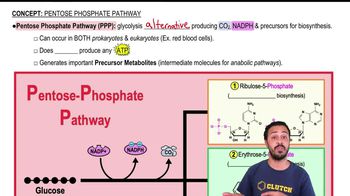
Pentose-Phosphate Pathway

Origin of Phosphoenolpyruvic Acid (PEP)

Phosphoenolpyruvic acid (PEP) is a high-energy intermediate produced in the glycolytic pathway. It is formed from 2-phosphoglycerate and plays a key role in energy transfer and as a substrate for biosynthetic reactions, including aromatic amino acid synthesis.
Recommended video:

Biosynthesis of Aromatic Amino Acids and Feedback Inhibition

The biosynthesis of tryptophan, tyrosine, and phenylalanine begins with DAHAP, formed from erythrose 4-phosphate and PEP. Each amino acid regulates its own synthesis through feedback inhibition, where the end product inhibits the synthetase enzyme to maintain metabolic balance.
Recommended video: