
Ch. 7 - The Control of Microbial Growth
Tortora - Microbiology: An Introduction 14th Edition
Tortora14th EditionMicrobiology: An IntroductionISBN: 9780138200398Not the one you use?Change textbook
Chapter 7, Problem 8

Which of the following is not a characteristic of quaternary ammonium compounds?
a. Bactericidal against gram-positive bacteria
b. Sporicidal
c. Amebicidal
d. Fungicidal
e. Kills enveloped viruses

Verified step by step guidance
1
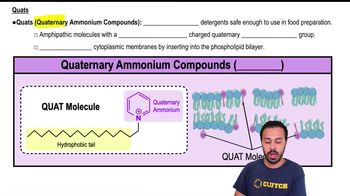
Step 1: Understand what quaternary ammonium compounds (quats) are. They are cationic surfactants commonly used as disinfectants and antiseptics, known for their ability to disrupt microbial cell membranes.
Step 2: Review the typical antimicrobial spectrum of quats. They are generally effective against gram-positive bacteria, some gram-negative bacteria, fungi, and enveloped viruses due to their membrane-disrupting action.
Step 3: Analyze each option in the question by comparing it to the known spectrum of quats: (a) bactericidal against gram-positive bacteria - quats are effective here; (b) sporicidal - quats are generally not effective against bacterial spores; (c) amebicidal - quats can kill some protozoa like amoebae; (d) fungicidal - quats have activity against fungi; (e) kills enveloped viruses - quats are effective against enveloped viruses.
Step 4: Identify which characteristic does not align with the known properties of quats. Since quats are not sporicidal, option (b) is the characteristic that does not apply.
Step 5: Conclude that the correct answer is the one that states quats are sporicidal, as this is not true for quaternary ammonium compounds.

Verified video answer for a similar problem:

This video solution was recommended by our tutors as helpful for the problem above.
Video duration:
2m
Was this helpful?

Key Concepts

Here are the essential concepts you must grasp in order to answer the question correctly.

Quaternary Ammonium Compounds (Quats)

Quaternary ammonium compounds are cationic surfactants commonly used as disinfectants. They disrupt microbial cell membranes, making them effective against many bacteria, fungi, and enveloped viruses. Their mode of action involves membrane destabilization and leakage of cellular contents.
Recommended video:

Spectrum of Antimicrobial Activity

Understanding the range of microbes affected by a disinfectant is crucial. Quats are generally bactericidal against gram-positive bacteria, fungicidal, amebicidal, and effective against enveloped viruses, but they lack sporicidal activity, meaning they cannot reliably kill bacterial spores.
Recommended video:
Guided course
04:29
Electromagnetic Spectrum

Sporicidal Activity

Sporicidal agents can destroy bacterial spores, which are highly resistant dormant forms. Most disinfectants, including quaternary ammonium compounds, do not have sporicidal properties, requiring stronger agents like bleach or autoclaving for spore elimination.
Recommended video:
Guided course
02:37
Active Transport
Related Practice
Textbook Question

How do salts and sugars preserve foods? Why are these considered physical rather than chemical methods of microbial control? Name one food that is preserved with sugar and one preserved with salt. How do you account for the occasional growth of Penicillium mold in jelly, which is 50% sucrose?

Textbook Question

You and your classmates are trying to determine how a disinfectant might kill cells. You observe that when you spill the disinfectant in a tube of reduced litmus milk, the litmus turns blue again. You suggest to your classmates that:

a. The disinfectant might inhibit cell wall synthesis

b. The disinfectant might oxidize molecules

c. The disinfectant might inhibit protein synthesis

d. The disinfectant might denature proteins

e. The disinfectant might damage DNA

1
views
Textbook Question

How do autoclaving, hot air, and ultra-high-temperature pasteurization illustrate the concept of equivalent treatments?

1
views
Textbook Question

A large hospital washes burn patients in a stainless steel tub. After each patient, the tub is cleaned with a quat. It was noticed that 14 of 20 burn patients acquired Pseudomonas infections after being bathed. Provide an explanation for this high rate of infection.

5
views
Textbook Question

The use-dilution values for two disinfectants tested under the same conditions are as follows:

Disinfectant A—1:2

Disinfectant B—1:10,000.

If both disinfectants are designed for the same purpose, which would you select?

1
views
Textbook Question

Use the following information to answer questions 6 and 7. The data were obtained from a use-dilution test comparing four disinfectants against Salmonella Choleraesuis.

G = growth, NG = no growth

Which disinfectant(s) is (are) bactericidal?

a. A,B,C, and D

b. A,C, and D

c. A only

d. B only

e. None of the above

1
views