
Ch. 7 - The Control of Microbial Growth
Tortora - Microbiology: An Introduction 14th Edition
Tortora14th EditionMicrobiology: An IntroductionISBN: 9780138200398Not the one you use?Change textbook
Chapter 7, Problem 9

A large hospital washes burn patients in a stainless steel tub. After each patient, the tub is cleaned with a quat. It was noticed that 14 of 20 burn patients acquired Pseudomonas infections after being bathed. Provide an explanation for this high rate of infection.

Verified step by step guidance
1
Step 1: Understand the nature of Pseudomonas species, especially Pseudomonas aeruginosa, which is a common opportunistic pathogen known for thriving in moist environments and its resistance to many disinfectants.
Step 2: Recognize that quaternary ammonium compounds (quats) are disinfectants effective against many bacteria but have limited efficacy against Pseudomonas due to its intrinsic resistance mechanisms, such as efflux pumps and biofilm formation.
Step 3: Consider that the stainless steel tub, being a moist environment, can serve as a reservoir for Pseudomonas, especially if the quat cleaning does not fully eliminate the bacteria or if biofilms have formed on the tub surfaces.
Step 4: Analyze how incomplete disinfection allows Pseudomonas to persist in the tub, leading to contamination of burn patients during bathing, which explains the high infection rate observed.
Step 5: Conclude that to reduce infections, alternative or additional disinfection methods effective against Pseudomonas should be used, and strict protocols to prevent biofilm formation and ensure thorough cleaning must be implemented.

Verified video answer for a similar problem:

This video solution was recommended by our tutors as helpful for the problem above.
Video duration:
2m
Was this helpful?

Key Concepts

Here are the essential concepts you must grasp in order to answer the question correctly.

Pseudomonas aeruginosa Characteristics

Pseudomonas aeruginosa is a common opportunistic pathogen known for its ability to survive in moist environments and resist many disinfectants. It forms biofilms, which protect it from chemical agents, making it a frequent cause of hospital-acquired infections, especially in burn patients with compromised skin barriers.
Recommended video:
Guided course
05:09
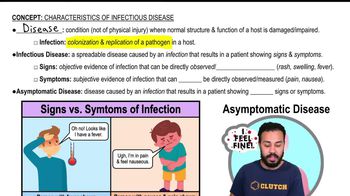
Intro to Characteristics of Infectious Disease

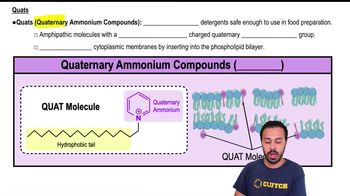
Quaternary Ammonium Compounds (Quats) and Their Limitations

Quats are disinfectants effective against many bacteria but have limited efficacy against Pseudomonas due to its resistance mechanisms and biofilm formation. Improper use or insufficient contact time of quats can fail to eliminate Pseudomonas, allowing it to persist on surfaces like stainless steel tubs.
Recommended video:

Infection Control in Burn Patients

Burn patients have damaged skin, which is a critical barrier against infection, making them highly susceptible to pathogens. Strict infection control, including effective cleaning protocols and use of appropriate disinfectants, is essential to prevent colonization and infection by resistant organisms like Pseudomonas.
Recommended video:
Guided course
04:52
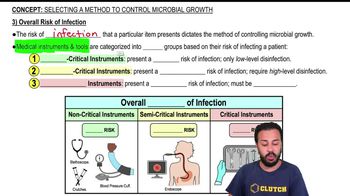
Overall Risk of Infection
Related Practice
Textbook Question

How do salts and sugars preserve foods? Why are these considered physical rather than chemical methods of microbial control? Name one food that is preserved with sugar and one preserved with salt. How do you account for the occasional growth of Penicillium mold in jelly, which is 50% sucrose?

Textbook Question

What bacteria have porins, are resistant to bisphenols, and survive and may grow in quats?

2
views
Textbook Question

You and your classmates are trying to determine how a disinfectant might kill cells. You observe that when you spill the disinfectant in a tube of reduced litmus milk, the litmus turns blue again. You suggest to your classmates that:

a. The disinfectant might inhibit cell wall synthesis

b. The disinfectant might oxidize molecules

c. The disinfectant might inhibit protein synthesis

d. The disinfectant might denature proteins

e. The disinfectant might damage DNA

1
views
Textbook Question

Which of the following is not a characteristic of quaternary ammonium compounds?

a. Bactericidal against gram-positive bacteria

b. Sporicidal

c. Amebicidal

d. Fungicidal

e. Kills enveloped viruses

1
views
Textbook Question

The use-dilution values for two disinfectants tested under the same conditions are as follows:

Disinfectant A—1:2

Disinfectant B—1:10,000.

If both disinfectants are designed for the same purpose, which would you select?

1
views
Textbook Question

Which of the following is most likely to be bactericidal?

a. Membrane filtration

b. Ionizing radiation

c. Lyophilization (freeze-drying)

d. Deep-freezing

e. All of the above

1
views