
Textbook Question
Fill in the following blanks.
a. 1 μm = ______ m
b. 1= _______ 10⁻⁹ m
c. 1 μm = ______ nm
4
views

 Verified step by step guidance
 01:51
01:51
 02:54
02:54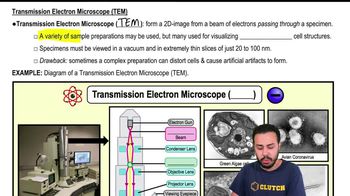 04:23
04:23Fill in the following blanks.
a. 1 μm = ______ m
b. 1= _______ 10⁻⁹ m
c. 1 μm = ______ nm
Assume you stain Bacillus by applying malachite green with heat and then counterstain with safranin. Through the microscope, the green structures are
a. Cell walls
b. Capsules
c. Endospores
d. Flagella
e. Impossible to identify
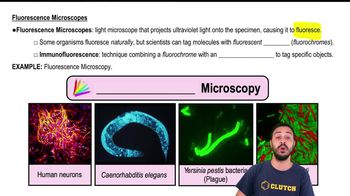
Looking at the cell of a photosynthetic microorganism, you observe the chloroplasts are green in brightfield microscopy and red in fluorescence microscopy. You conclude:
a. Chlorophyll is fluorescent
b. The magnification has distorted the image
c. You’re not looking at the same structure in both microscopes
d. The stain masked the green color
e. None of the above
Which type of microscope would be best to use to observe each of the following?
a. A stained bacterial smear
b. Unstained bacterial cells: the cells are small, and no detail is needed
c. Unstained live tissue when it is desirable to see some intracellular detail
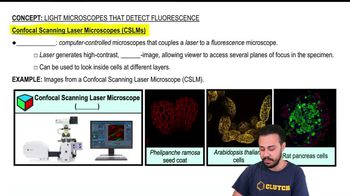
d. A sample that emits light when illuminated with ultraviolet light
e. Intracellular detail of a cell that is 1μm long
f. Unstained live cells in which intracellular structures are shown in color
Carbolfuchsin can be used as a simple stain and a negative stain. As a simple stain, the pH is:
a. 2
b. Higher than the negative stain
c. Lower than the negative stain
d. The same as the negative stain