Ch. 9 - Controlling Microbial Growth in the Environment
Bauman - Microbiology with Diseases by Taxonomy 6th Edition
Bauman6th EditionMicrobiology with Diseases by TaxonomyISBN: 9780134832302Not the one you use?Change textbook
Chapter 9, Problem 15

Which of the following substances is least toxic to humans?
a. Carbolic acid
b. Glutaraldehyde
c. Hydrogen peroxide
d. Formalin

Verified step by step guidance
1
Step 1: Understand the toxicity of each substance listed by reviewing their common uses and effects on human health. Toxicity refers to how harmful a substance is to living organisms, including humans.
Step 2: Carbolic acid (phenol) is known to be quite toxic and corrosive, causing burns and systemic poisoning if absorbed in significant amounts.
Step 3: Glutaraldehyde is a potent disinfectant and sterilizing agent, but it is also toxic and can cause irritation and sensitization upon exposure.
Step 4: Hydrogen peroxide is commonly used as an antiseptic and disinfectant; at low concentrations, it is relatively safe and breaks down into water and oxygen, making it less toxic compared to the others.
Step 5: Formalin (a solution of formaldehyde) is highly toxic and a known carcinogen, causing irritation and serious health risks upon exposure.

Verified video answer for a similar problem:

This video solution was recommended by our tutors as helpful for the problem above.
Video duration:
3m
Was this helpful?

Key Concepts

Here are the essential concepts you must grasp in order to answer the question correctly.

Toxicity of Chemical Disinfectants

Toxicity refers to the degree to which a substance can harm humans or animals. Chemical disinfectants vary in toxicity based on their chemical structure and mode of action. Understanding toxicity helps determine safe handling and usage in medical or laboratory settings.
Recommended video:
Guided course
05:21
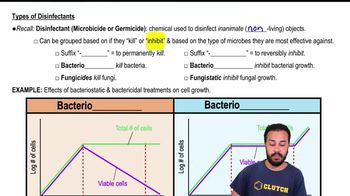
Types of Disinfectants

Properties and Uses of Common Disinfectants

Carbolic acid, glutaraldehyde, hydrogen peroxide, and formalin are widely used disinfectants with distinct chemical properties. Their effectiveness and toxicity differ, influencing their application in sterilization, antisepsis, or surface cleaning.
Recommended video:
Guided course
04:07
Properties of Water- Thermal

Hydrogen Peroxide as a Mild Disinfectant

Hydrogen peroxide is a strong oxidizing agent that breaks down into water and oxygen, making it less toxic and environmentally friendly. It is commonly used for wound cleaning and surface disinfection due to its relatively low toxicity compared to other chemicals.
Recommended video:
Guided course
05:03
Hydrogen Bonding