What are some advantages and disadvantages of using ionizing radiation to sterilize food?
Ch. 9 - Controlling Microbial Growth in the Environment
Bauman6th EditionMicrobiology with Diseases by TaxonomyISBN: 9780134832302Not the one you use?Change textbook
Chapter 9, Problem 13
Biosafety Level 3 includes:
a. Double sets of entry doors
b. Pressurized suits
c. Showers in entryways
d. All of the above
Verified step by step guidance1
Understand that Biosafety Levels (BSL) are a series of protections designed to contain infectious agents in laboratory settings, ranging from BSL-1 (lowest risk) to BSL-4 (highest risk).
Recall that BSL-3 laboratories are designed to work with pathogens that can cause serious or potentially lethal diseases through inhalation, requiring specific engineering and procedural controls.
Identify the typical features of BSL-3, which include controlled access, directional airflow, and specialized personal protective equipment, but do not usually require pressurized suits or showers in entryways.
Recognize that double sets of entry doors are a common feature of BSL-3 labs to maintain containment and prevent contamination.
Conclude that among the options given, only 'double sets of entry doors' correctly describe a BSL-3 feature, while pressurized suits and showers in entryways are more characteristic of BSL-4 facilities.

Verified video answer for a similar problem:
This video solution was recommended by our tutors as helpful for the problem above.
Video duration:
1mWas this helpful?
Key Concepts
Here are the essential concepts you must grasp in order to answer the question correctly.
Biosafety Levels (BSL)
Biosafety Levels are a series of protections designed to contain infectious agents in laboratories. They range from BSL-1 (lowest risk) to BSL-4 (highest risk), with each level requiring specific safety practices, equipment, and facility design to prevent exposure.
Recommended video:
Guided course
Substrate-Level Phosphorylation
Features of Biosafety Level 3 (BSL-3)
BSL-3 labs handle pathogens that can cause serious or potentially lethal diseases via inhalation. Key features include controlled access, double-door entry, directional airflow, and specialized personal protective equipment, but do not typically require pressurized suits or mandatory showers.
Recommended video:
Guided course
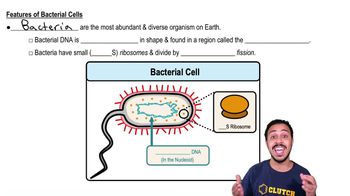
Features of Bacterial Cells
Personal Protective Equipment (PPE) and Facility Requirements
PPE and facility design vary by biosafety level. While BSL-3 requires respiratory protection and controlled access, pressurized suits and mandatory showers are characteristic of BSL-4 labs, which handle the most dangerous pathogens.
Recommended video:
Guided course
Situations Warranting Different Levels of Microbial Growth Control
Related Practice
Textbook Question
3
views
Textbook Question
Which of the following adjectives best describes a surgical procedure that is free of microbial contaminants?
a. Disinfected
b. Sanitized
c. Degermed
d. Aseptic
1
views
Textbook Question
Which of the following substances is least toxic to humans?
a. Carbolic acid
b. Glutaraldehyde
c. Hydrogen peroxide
d. Formalin
1
views
Textbook Question
Contrast the structures and actions of soaps and quats.
6
views
Textbook Question
A sample of E. coli has been subjected to heat for a specified time, and 90% of the cells have been destroyed. Which of the following terms best describes this event?
a. Thermal death point
b. Thermal death time
c. Decimal reduction time
d. None of the above
1
views
Textbook Question
Why are alcohols more effective in a 70% solution than in a 100% solution?
5
views