Ch. 3 - Introduction to Prokaryotic Cells
Norman-McKay- Microbiology: Basic and Clinical Principles 2nd Edition
Norman-McKay2nd EditionMicrobiology: Basic and Clinical PrinciplesISBN: 9780137661619Not the one you use?Change textbook
Chapter 3, Problem 8

Which of the following would you expect to find in acid-fast cell walls? Select all that
apply.
a. Peptidoglycan
b. Phospholipids
c. Lipopolysaccharide
d. Lipid A
e. Mycolic acid

Verified step by step guidance
1
Step 1: Understand the composition of acid-fast bacterial cell walls. Acid-fast bacteria, such as Mycobacterium species, have a unique cell wall structure that differs from typical Gram-positive and Gram-negative bacteria.
Step 2: Recall that acid-fast cell walls contain peptidoglycan, which is a common component of bacterial cell walls providing structural support. So, peptidoglycan is present.
Step 3: Recognize that acid-fast bacteria have a high lipid content in their cell walls, especially mycolic acids, which are long-chain fatty acids that make the cell wall waxy and resistant to staining and chemicals.
Step 4: Consider phospholipids, which are components of all biological membranes, including bacterial cytoplasmic membranes, so they are present but not unique to acid-fast cell walls.
Step 5: Understand that lipopolysaccharide (LPS) and its component lipid A are characteristic of the outer membrane of Gram-negative bacteria, not acid-fast bacteria, so these would not be expected in acid-fast cell walls.

Verified video answer for a similar problem:

This video solution was recommended by our tutors as helpful for the problem above.
Video duration:
2m
Was this helpful?

Key Concepts

Here are the essential concepts you must grasp in order to answer the question correctly.

Acid-Fast Cell Wall Structure

Acid-fast bacteria, such as Mycobacterium species, have a unique cell wall rich in mycolic acids, which are long-chain fatty acids that provide a waxy, hydrophobic barrier. This structure makes them resistant to decolorization by acid-alcohol during staining, distinguishing them from other bacteria.
Recommended video:
Guided course
02:59
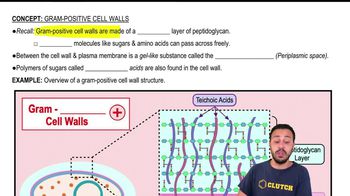
Gram-Positive Cell Walls

Peptidoglycan Layer in Bacterial Cell Walls

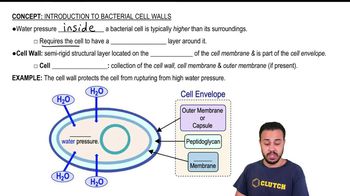
Peptidoglycan is a polymer that forms a rigid layer in bacterial cell walls, providing structural support. Acid-fast bacteria contain peptidoglycan beneath their mycolic acid layer, similar to Gram-positive bacteria, but it is masked by the thick lipid-rich outer layer.
Recommended video:
Guided course
03:44
Introduction to Bacterial Cell Walls

Lipopolysaccharide and Lipid A in Gram-Negative Bacteria

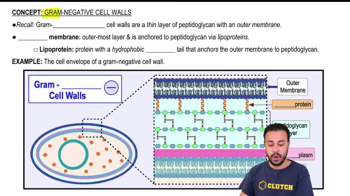
Lipopolysaccharide (LPS) and its component Lipid A are found in the outer membrane of Gram-negative bacteria, contributing to their structural integrity and pathogenicity. Acid-fast bacteria do not have LPS or Lipid A, as their cell wall composition differs significantly from Gram-negative bacteria.
Recommended video:
Guided course
3:04
Gram-Negative Cell Walls