Where specifically does the most significant production of ATP occur in prokaryotic and eukaryotic cells?
Ch. 5 - Microbial Metabolism
Bauman6th EditionMicrobiology with Diseases by TaxonomyISBN: 9780134832302Not the one you use?Change textbook
Chapter 5, Problem 14
Most oxidation reactions in bacteria involve the _______.
a. Removal of hydrogen ions and electrons
b. Removal of oxygen
c. Addition of hydrogen ions and electrons
d. Addition of hydrogen ions
Verified step by step guidance1
Understand that oxidation reactions in bacteria typically involve the loss of electrons. This is a fundamental concept in redox reactions where oxidation means losing electrons and reduction means gaining electrons.
Recall that in biological systems, electrons are often removed along with hydrogen atoms because hydrogen atoms consist of one proton and one electron. Therefore, oxidation often involves the removal of hydrogen ions (protons) and electrons together.
Analyze each option in the context of oxidation: (a) removal of hydrogen ions and electrons aligns with the concept of oxidation; (b) removal of oxygen is not typically how oxidation is defined in bacteria; (c) addition of hydrogen ions and electrons corresponds to reduction, not oxidation; (d) addition of hydrogen ions alone does not represent oxidation.
Conclude that the correct description of most oxidation reactions in bacteria is the removal of hydrogen ions and electrons, which corresponds to option (a).
Summarize that oxidation in bacterial metabolism generally involves the loss of electrons and protons, facilitating energy production through electron transport chains.

Verified video answer for a similar problem:
This video solution was recommended by our tutors as helpful for the problem above.
Video duration:
1mWas this helpful?
Key Concepts
Here are the essential concepts you must grasp in order to answer the question correctly.
Oxidation Reactions in Microbiology
Oxidation reactions involve the loss of electrons from a molecule, atom, or ion. In bacteria, these reactions are crucial for energy production, often involving the transfer of electrons and hydrogen ions to electron carriers.
Recommended video:
Guided course
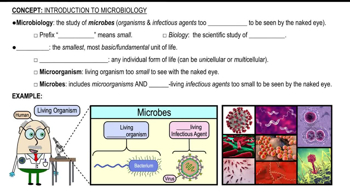
Introduction to Microbiology
Role of Hydrogen Ions and Electrons in Oxidation
During oxidation, bacteria typically remove hydrogen atoms, which consist of one proton (hydrogen ion) and one electron. This removal facilitates electron transport and energy generation in cellular respiration.
Recommended video:
Guided course
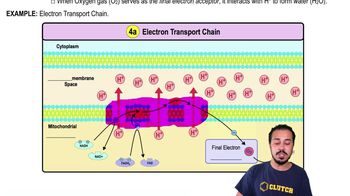
Electron Transport Chain
Difference Between Oxidation and Reduction
Oxidation is the loss of electrons or hydrogen atoms, while reduction is the gain of electrons or hydrogen atoms. Understanding this distinction helps clarify that oxidation involves removal, not addition, of hydrogen ions and electrons.
Recommended video:
Guided course
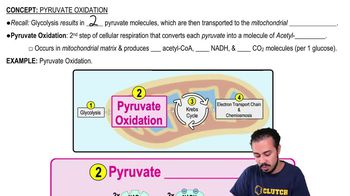
Pyruvate Oxidation
Related Practice
Textbook Question
4
views
Textbook Question
Which of the following does not affect the function of enzymes?
a. Ubiquinone
b. Substrate concentration
c. Temperature
d. Competitive inhibitors
1
views
Textbook Question
Under ideal conditions, the fermentation of one glucose molecule by a bacterium allows a net gain of how many ATP molecules?
a. 2
b. 4
c. 38
d. 0
1
views
Textbook Question
Under ideal conditions, the complete aerobic oxidation of one molecule of glucose by a bacterium allows a net gain of how many ATP molecules?
a. 2
b. 4
c. 38
d. 0
3
views
Textbook Question
Why are vitamins essential metabolic factors for microbial metabolism?
1
views
Textbook Question
A laboratory scientist notices that a certain bacterium does not utilize lactose when glucose is available in its environment. Describe a cellular regulatory mechanism that would explain this observation.
1
views