Where specifically does the most significant production of ATP occur in prokaryotic and eukaryotic cells?
Ch. 5 - Microbial Metabolism
Bauman6th EditionMicrobiology with Diseases by TaxonomyISBN: 9780134832302Not the one you use?Change textbook
Chapter 5, Problem 13
Which of the following does not affect the function of enzymes?
a. Ubiquinone
b. Substrate concentration
c. Temperature
d. Competitive inhibitors
Verified step by step guidance1
Step 1: Understand the role of enzymes and factors that influence their activity. Enzymes are biological catalysts that speed up chemical reactions, and their function can be affected by various factors.
Step 2: Analyze each option to determine if it affects enzyme function. Substrate concentration affects enzyme activity because it influences the rate at which enzymes bind to substrates.
Step 3: Temperature affects enzyme function by altering the enzyme's shape and activity; too high or too low temperatures can denature enzymes or reduce their efficiency.
Step 4: Competitive inhibitors affect enzyme function by binding to the active site, preventing substrate binding and thus reducing enzyme activity.
Step 5: Ubiquinone is a molecule involved in the electron transport chain, not directly related to enzyme activity modulation, so it does not affect enzyme function in the context of enzyme catalysis.

Verified video answer for a similar problem:
This video solution was recommended by our tutors as helpful for the problem above.
Video duration:
1mWas this helpful?
Key Concepts
Here are the essential concepts you must grasp in order to answer the question correctly.
Enzyme Function and Activity
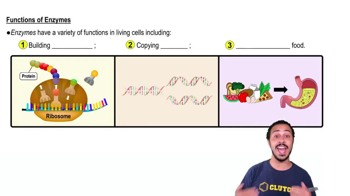
Enzymes are biological catalysts that speed up chemical reactions by lowering activation energy. Their function depends on factors like substrate binding, environmental conditions, and the presence of inhibitors, which can enhance or reduce their catalytic efficiency.
Recommended video:
Guided course
Functions of Enzymes
Factors Affecting Enzyme Activity
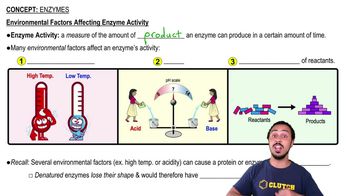
Enzyme activity is influenced by substrate concentration, temperature, pH, and inhibitors. Substrate concentration affects the rate until saturation, temperature affects molecular movement and enzyme stability, and inhibitors can block active sites or alter enzyme shape.
Recommended video:
Guided course
Environmental Factors Affecting Enzyme Activity
Competitive Inhibition
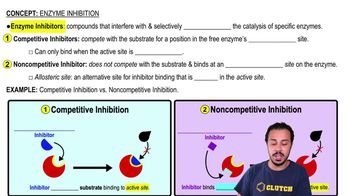
Competitive inhibitors resemble the substrate and bind to the enzyme's active site, preventing substrate binding. This type of inhibition reduces enzyme activity but can be overcome by increasing substrate concentration, distinguishing it from other inhibition types.
Recommended video:
Guided course
Enzyme Inhibition
Related Practice
Textbook Question
4
views
Textbook Question
Under ideal conditions, the fermentation of one glucose molecule by a bacterium allows a net gain of how many ATP molecules?
a. 2
b. 4
c. 38
d. 0
1
views
Textbook Question
Most oxidation reactions in bacteria involve the _______.
a. Removal of hydrogen ions and electrons
b. Removal of oxygen
c. Addition of hydrogen ions and electrons
d. Addition of hydrogen ions
1
views
Textbook Question
How do yeast cells make alcohol and cause bread to rise?
1
views
Textbook Question
Why are vitamins essential metabolic factors for microbial metabolism?
1
views
Textbook Question
Which of the following statements best describes ribozymes?
a. Ribozymes are proteins that aid in the production of ribosomes.
b. Ribozymes are nucleic acids that produce ribose sugars.
c. Ribozymes store enzymes in ribosomes.
d. Ribozymes process RNA molecules in eukaryotes.
1
views