Ch. 7 - Microbial Genetics
Bauman - Microbiology with Diseases by Taxonomy 6th Edition
Bauman6th EditionMicrobiology with Diseases by TaxonomyISBN: 9780134832302Not the one you use?Change textbook
Chapter 7, Problem 21

Repressible operons are important in regulating prokaryotic:
a. DNA replication
b. RNA transcription
c. rRNA processing
d. Sugar catabolism

Verified step by step guidance
1
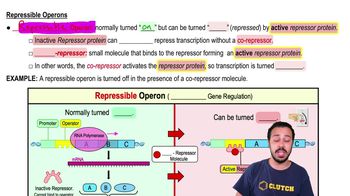
Understand the concept of a repressible operon: it is a type of operon in prokaryotes that is usually active but can be turned off (repressed) when a specific molecule, often the end product of a metabolic pathway, is present.
Recall that operons regulate gene expression primarily at the level of RNA transcription by controlling whether RNA polymerase can transcribe the genes in the operon.
Identify that repressible operons typically control biosynthetic pathways, where the end product acts as a corepressor to inhibit transcription when it is abundant.
Evaluate the options: DNA replication is not regulated by operons; rRNA processing is a post-transcriptional modification; sugar catabolism is often regulated by inducible operons, not repressible ones.
Conclude that repressible operons are important in regulating RNA transcription, making option (b) the correct focus.

Verified video answer for a similar problem:

This video solution was recommended by our tutors as helpful for the problem above.
Video duration:
2m
Was this helpful?

Key Concepts

Here are the essential concepts you must grasp in order to answer the question correctly.

Repressible Operons

Repressible operons are gene clusters in prokaryotes that are usually active but can be turned off (repressed) when a specific molecule, often the end product of a metabolic pathway, is abundant. This regulation helps conserve resources by stopping the synthesis of enzymes no longer needed.
Recommended video:
Guided course
03:42
Repressible Operons

Regulation of RNA Transcription

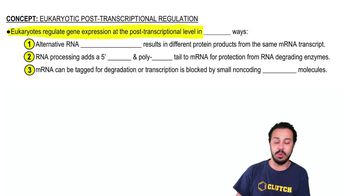
Operons control gene expression primarily at the transcriptional level by regulating RNA polymerase activity. In repressible operons, a repressor protein binds to the operator region to block RNA transcription when the corepressor is present, preventing mRNA synthesis.
Recommended video:
Guided course
01:56
Eukaryotic Post-Transcriptional Regulation

Metabolic Pathways and Gene Regulation

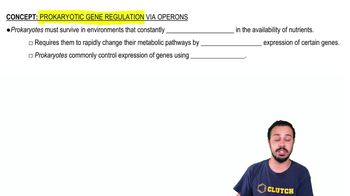
Repressible operons often regulate genes involved in biosynthetic pathways, such as amino acid synthesis, where the end product acts as a corepressor. This feedback mechanism ensures that enzymes for producing a metabolite are only made when needed, optimizing cellular efficiency.
Recommended video:
Guided course
00:53
Prokaryotic Gene Regulation via Operons