Ch. 7 - Microbial Genetics
Bauman - Microbiology with Diseases by Taxonomy 6th Edition
Bauman6th EditionMicrobiology with Diseases by TaxonomyISBN: 9780134832302Not the one you use?Change textbook
Chapter 7, Problem 22

Which of the following is part of each molecule of mRNA?
a. Palindrome
b. Codon
c. Anticodon
d. Base pair

Verified step by step guidance
1
Understand the structure and function of mRNA (messenger RNA). mRNA is a single-stranded molecule that carries genetic information from DNA to the ribosome for protein synthesis.
Recall that mRNA is composed of sequences of nucleotides arranged in groups of three called codons. Each codon specifies a particular amino acid during translation.
Recognize that a palindrome is a sequence that reads the same forwards and backwards, which is not a defining feature of mRNA molecules.
Note that an anticodon is a sequence found on tRNA (transfer RNA), not on mRNA. Anticodons pair with codons during translation.
Understand that base pairs refer to the hydrogen bonding between complementary nucleotides in double-stranded nucleic acids like DNA, but mRNA is single-stranded and does not have base pairs within its own molecule.

Verified video answer for a similar problem:

This video solution was recommended by our tutors as helpful for the problem above.
Video duration:
2m
Was this helpful?

Key Concepts

Here are the essential concepts you must grasp in order to answer the question correctly.

mRNA Structure and Function

Messenger RNA (mRNA) is a single-stranded molecule that carries genetic information from DNA to the ribosome for protein synthesis. It contains sequences called codons, which are groups of three nucleotides that specify amino acids. Understanding mRNA's role is essential to identify its components.
Recommended video:
Guided course
06:04
Functional Groups

Codon

A codon is a sequence of three nucleotides on mRNA that corresponds to a specific amino acid or a stop signal during translation. Each mRNA molecule is composed of multiple codons, making codons fundamental units for decoding genetic information into proteins.
Recommended video:
Guided course
11:39
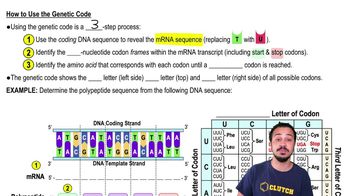
How to Use the Genetic Code

Anticodon

An anticodon is a sequence of three nucleotides on transfer RNA (tRNA) that pairs complementarily with an mRNA codon during translation. Anticodons are not part of mRNA molecules but are crucial for matching amino acids to the correct codons.
Recommended video:
Guided course
06:12
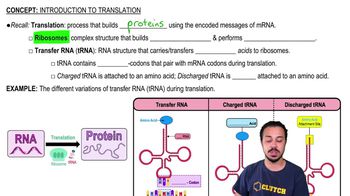
Introduction to Translation