
Ch. 10 - Classification of Microorganisms
Tortora - Microbiology: An Introduction 14th Edition
Tortora14th EditionMicrobiology: An IntroductionISBN: 9780138200398Not the one you use?Change textbook
Chapter 10, Problem 10

Use the following choices to answer questions 9 and 10.
1. 9 + 2 flagella
2. 70s ribosome
3. fimbria
4. nucleus
5. peptidoglycan
6. plasma membrane
Which is (are) found only in prokaryotes?
a. 1,4,6
b. 3,5
c. 1,2
d. 4
e. 2,4,5

Verified step by step guidance
1
Step 1: Identify the structures or components listed and determine whether they are found in prokaryotes, eukaryotes, or both. For example, understand that a nucleus (choice 4) is a defining feature of eukaryotic cells and is absent in prokaryotes.
Step 2: Recognize that peptidoglycan (choice 5) is a unique component of the bacterial cell wall, which is characteristic of prokaryotes and not found in eukaryotic cells.
Step 3: Understand that fimbriae (choice 3) are hair-like appendages found on many prokaryotic cells used for attachment, and are generally absent in eukaryotic cells.
Step 4: Analyze the options given in the multiple-choice answers and match them with the components exclusive to prokaryotes based on your knowledge from the previous steps.
Step 5: Conclude which combination of choices corresponds to structures found only in prokaryotes by eliminating those that include eukaryotic features such as the nucleus.

Verified video answer for a similar problem:

This video solution was recommended by our tutors as helpful for the problem above.
Was this helpful?

Key Concepts

Here are the essential concepts you must grasp in order to answer the question correctly.

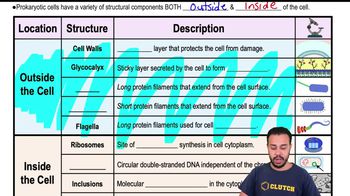
Prokaryotic Cell Structures

Prokaryotic cells lack a nucleus and membrane-bound organelles. They have unique features such as 70s ribosomes, peptidoglycan in their cell walls, and structures like fimbriae and flagella with a 9 + 2 arrangement. Understanding these structures helps differentiate prokaryotes from eukaryotes.
Recommended video:
Guided course
05:59
Overview of Prokaryotic Cell Structure

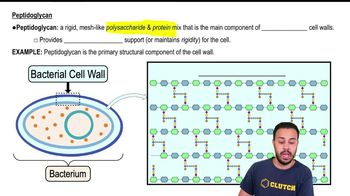
Peptidoglycan

Peptidoglycan is a polymer forming a rigid cell wall layer found only in bacteria, a major group of prokaryotes. It provides structural support and shape, protecting cells from osmotic pressure. This molecule is absent in eukaryotic cells, making it a key marker for prokaryotes.
Recommended video:
Guided course
01:58
Peptidoglycan

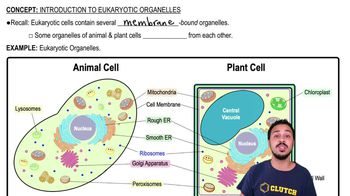
Nucleus and Membrane-bound Organelles

The nucleus is a defining feature of eukaryotic cells, containing genetic material enclosed by a membrane. Prokaryotes lack a nucleus and instead have a nucleoid region. Recognizing the presence or absence of a nucleus is essential for distinguishing prokaryotic from eukaryotic cells.
Recommended video:
Guided course
03:45
Introduction to Eukaryotic Organelles