
Ch. 10 - Classification of Microorganisms
Tortora - Microbiology: An Introduction 14th Edition
Tortora14th EditionMicrobiology: An IntroductionISBN: 9780138200398Not the one you use?Change textbook
Chapter 10, Problem 8

Use the following choices to answer questions 7 and 8.
a. Animalia
b. Fungi
c. Plantae
d. Bacillota (gram-positive bacteria)
e. Pseudomonadota (gram-negative bacteria)
Into which group would you place a photosynthetic organism that lacks a nucleus and has a thin peptidoglycan wall surrounded by an outer membrane?

Verified step by step guidance
1
Identify the key characteristics of the organism described: it is photosynthetic, lacks a nucleus, and has a thin peptidoglycan wall surrounded by an outer membrane.
Recall that organisms lacking a nucleus are prokaryotes, which excludes groups Animalia, Fungi, and Plantae because they are eukaryotic.
Understand that the presence of a thin peptidoglycan layer surrounded by an outer membrane is characteristic of gram-negative bacteria.
Recognize that photosynthetic prokaryotes with these cell wall features are typically classified under Pseudomonadota (gram-negative bacteria).
Match the organism's features to the correct group from the choices provided, which is Pseudomonadota (gram-negative bacteria).

Verified video answer for a similar problem:

This video solution was recommended by our tutors as helpful for the problem above.
Was this helpful?

Key Concepts

Here are the essential concepts you must grasp in order to answer the question correctly.

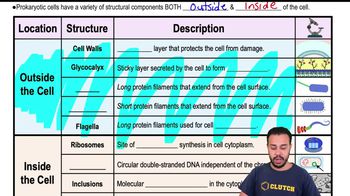
Prokaryotic Cell Structure

Prokaryotic cells lack a nucleus and membrane-bound organelles. Their genetic material is free-floating in the cytoplasm. Understanding this helps distinguish prokaryotes from eukaryotes, which have a defined nucleus.
Recommended video:
Guided course
05:59
Overview of Prokaryotic Cell Structure

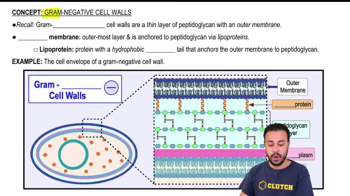
Gram-negative Bacterial Cell Wall

Gram-negative bacteria have a thin peptidoglycan layer located between an inner cytoplasmic membrane and an outer membrane containing lipopolysaccharides. This structure differs from gram-positive bacteria, which have a thick peptidoglycan wall but no outer membrane.
Recommended video:
Guided course
3:04
Gram-Negative Cell Walls

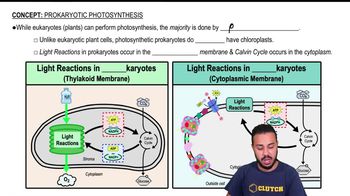
Photosynthetic Prokaryotes

Some prokaryotes, like cyanobacteria, perform photosynthesis despite lacking a nucleus. They contain pigments such as chlorophyll and have cell walls typical of gram-negative bacteria, enabling them to produce energy from sunlight.
Recommended video:
Guided course
02:42
Prokaryotic Photosynthesis
Related Practice
Textbook Question

Use the following choices to answer questions 7 and 8.

a. Animalia

b. Fungi

c. Plantae

d. Bacillota (gram-positive bacteria)

e. Pseudomonadota (gram-negative bacteria)

Into which group would you place a multicellular organism that has a mouth and lives inside the human liver?

Textbook Question

The wall-less mycoplasmas are considered to be related to gram-positive bacteria. Which of the following would provide the most compelling evidence for this?

a. They share common rRNA sequences.

b. Some gram-positive bacteria and some mycoplasmas produce catalase.

c. Both groups are prokaryotic.

d. Some gram-positive bacteria and some mycoplasmas have coccus-shaped cells.

e. Both groups contain human pathogens.

3
views
Textbook Question

Use the following choices to answer questions 9 and 10.

1. 9 + 2 flagella

2. 70s ribosome

3. fimbria

4. nucleus

5. peptidoglycan

6. plasma membrane

Which is (are) found only in prokaryotes?

a. 1,4,6

b. 3,5

c. 1,2

d. 4

e. 2,4,5

1
views
Textbook Question

You could identify an unknown bacterium by all of the following except

a. hybridizing a DNA probe from a known bacterium with the unknown’s DNA.

b. making a fatty acid profile of the unknown.

c. specific antiserum agglutinating the unknown.

d. ribosomal RNA sequencing.

e. percentage of guanine + cytosine.

5
views
Textbook Question

Use the following choices to answer questions 9 and 10.

1. 9 + 2 flagella

2. 70s ribosome

3. fimbria

4. nucleus

5. peptidoglycan

6. plasma membrane

Which is (are) found in all three domains?

a. 2,6

b. 5

c. 2,4,6

d. 1,3,5

e. all six

5
views