Ch. 7 - Microbial Genetics
Bauman - Microbiology with Diseases by Taxonomy 6th Edition
Bauman6th EditionMicrobiology with Diseases by TaxonomyISBN: 9780134832302Not the one you use?Change textbook
Chapter 7, Problem 17

A nucleotide is made of:
a. A five-carbon sugar
b. Phosphate
c. A nitrogenous base
d. All of the above

Verified step by step guidance
1
Understand that a nucleotide is the basic building block of nucleic acids like DNA and RNA.
Recall that each nucleotide consists of three main components: a five-carbon sugar, a phosphate group, and a nitrogenous base.
The five-carbon sugar can be either deoxyribose (in DNA) or ribose (in RNA).
The phosphate group links the sugar of one nucleotide to the sugar of the next nucleotide, forming the backbone of the nucleic acid strand.
The nitrogenous base (adenine, thymine, cytosine, guanine, or uracil) is attached to the sugar and is responsible for base pairing and encoding genetic information.

Verified video answer for a similar problem:

This video solution was recommended by our tutors as helpful for the problem above.
Video duration:
1m
Was this helpful?

Key Concepts

Here are the essential concepts you must grasp in order to answer the question correctly.

Structure of a Nucleotide

A nucleotide is the basic building block of nucleic acids like DNA and RNA. It consists of three components: a five-carbon sugar, a phosphate group, and a nitrogenous base. These components link together to form the backbone and informational units of genetic material.
Recommended video:
Guided course
06:24
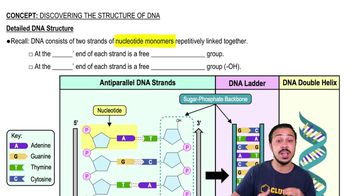
Detailed DNA Structure

Five-Carbon Sugar

The five-carbon sugar in nucleotides is either ribose (in RNA) or deoxyribose (in DNA). This sugar forms the central part of the nucleotide, connecting to both the phosphate group and the nitrogenous base, and helps establish the nucleotide’s identity and function.
Recommended video:

Nitrogenous Bases

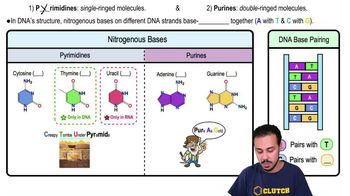
Nitrogenous bases are organic molecules that contain nitrogen and act as the information carriers in nucleotides. They are classified into purines (adenine and guanine) and pyrimidines (cytosine, thymine in DNA, and uracil in RNA), and their sequence encodes genetic information.
Recommended video:
Guided course
07:21
5 Nitrogenous Bases