How do organisms control the rate of metabolic activities in their cells?
Ch. 5 - Microbial Metabolism
Bauman6th EditionMicrobiology with Diseases by TaxonomyISBN: 9780134832302Not the one you use?Change textbook
Chapter 5, Problem 3
For the phrase given below, indicate the type of metabolism referred to, using the following choices:
a. Anabolism only
b. Both anabolism and catabolism (amphibolic)
c. Catabolism only
Is exergonic
Verified step by step guidance1
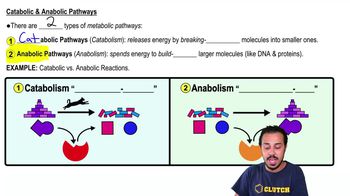
Understand the definitions of the metabolism types: Anabolism refers to biosynthetic processes that build complex molecules from simpler ones and generally require energy input (endergonic). Catabolism refers to the breakdown of complex molecules into simpler ones, releasing energy (exergonic). Amphibolic pathways involve both anabolic and catabolic reactions.
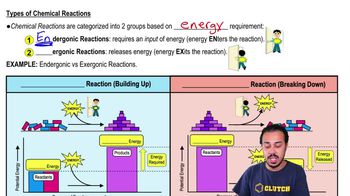
Analyze the phrase 'Is exergonic' which means the process releases energy. Since catabolic reactions release energy, this phrase is describing a catabolic process.
Recall that anabolic processes are endergonic (require energy), so 'exergonic' cannot describe anabolism only.
Since the phrase does not indicate both building up and breaking down molecules, it does not describe an amphibolic pathway.
Conclude that the metabolism type referred to by 'Is exergonic' is catabolism only.

Verified video answer for a similar problem:
This video solution was recommended by our tutors as helpful for the problem above.
Video duration:
1mWas this helpful?
Key Concepts
Here are the essential concepts you must grasp in order to answer the question correctly.
Catabolism
Catabolism refers to the metabolic pathways that break down molecules into smaller units, releasing energy in the process. These reactions are typically exergonic, meaning they release energy that the cell can use for various functions.
Recommended video:
Guided course
Catabolic & Anabolic Pathways
Anabolism
Anabolism involves metabolic pathways that build complex molecules from simpler ones, requiring an input of energy. These reactions are endergonic, meaning they consume energy to synthesize cellular components like proteins and nucleic acids.
Recommended video:
Guided course
Catabolic & Anabolic Pathways
Exergonic Reactions
Exergonic reactions release energy as they proceed, often driving cellular processes. In metabolism, catabolic pathways are usually exergonic, providing the energy needed for anabolic reactions and other cellular activities.
Recommended video:
Guided course
Types of Chemical Reactions
Related Practice
Textbook Question
Textbook Question
For the phrase given below, indicate the type of metabolism referred to, using the following choices:
a. Anabolism only
b. Both anabolism and catabolism (amphibolic)
c. Catabolism only
Is endergonic
1
views
Textbook Question
_______ is a cyclic series of eight reactions involved in the catabolism of acetyl-CoA that yields eight molecules of NADH and two molecules of FADH2.
4
views
Textbook Question
Examine the biosynthetic pathway for the production of the amino acids tryptophan, tyrosine, and phenylalanine in the figure. Where do the initial reactants (erythrose 4-phosphate and PEP) originate?
Textbook Question
The initial catabolism of glucose occurs by glycolysis and/or the ________ and ________pathways.
Textbook Question
How does a noncompetitive inhibitor at a single allosteric site affect a whole pathway of enzymatic reactions?
1
views