
Ch. 22 - Microbial Diseases of the Nervous System
Tortora - Microbiology: An Introduction 14th Edition
Tortora14th EditionMicrobiology: An IntroductionISBN: 9780138200398Not the one you use?Change textbook
Chapter 22, Problem 5

Endotoxin is responsible for symptoms caused by which of the following organisms?
a. N. meningitidis
b. S. pyogenes
c. L. monocytogenes
d. C. tetani
e. C. botulinum

Verified step by step guidance
1
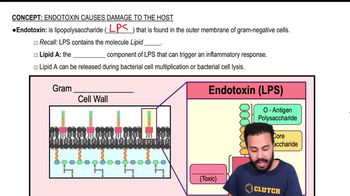
Understand what an endotoxin is: Endotoxins are lipopolysaccharides (LPS) found in the outer membrane of Gram-negative bacteria. They are released when the bacteria die and cause symptoms such as fever, inflammation, and shock.
Identify which organisms in the list are Gram-negative: Among the options, Neisseria meningitidis (N. meningitidis) is a Gram-negative bacterium, while the others are Gram-positive.
Recall that Gram-positive bacteria do not have an outer membrane and therefore do not produce endotoxins; instead, they may produce exotoxins.
Match the organism that produces endotoxin with the symptoms caused by endotoxin: Since N. meningitidis is Gram-negative, it produces endotoxin responsible for symptoms like meningitis and septic shock.
Conclude that the correct organism responsible for symptoms caused by endotoxin is N. meningitidis.

Verified video answer for a similar problem:

This video solution was recommended by our tutors as helpful for the problem above.
Video duration:
1m
Was this helpful?

Key Concepts

Here are the essential concepts you must grasp in order to answer the question correctly.

Endotoxins

Endotoxins are toxic components of the outer membrane of Gram-negative bacteria, primarily lipopolysaccharides (LPS). They are released when the bacteria die or multiply, triggering strong immune responses such as fever, inflammation, and septic shock.
Recommended video:

Gram-negative vs. Gram-positive Bacteria

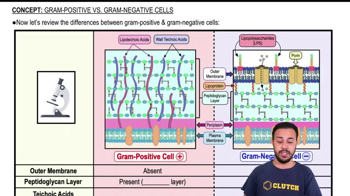
Gram-negative bacteria have an outer membrane containing endotoxins, while Gram-positive bacteria lack this outer membrane and instead produce exotoxins. This distinction is crucial for understanding which organisms cause symptoms via endotoxins.
Recommended video:
Guided course
04:46
Gram-Positive vs. Gram-Negative Cell Walls

Pathogenic Organisms Listed

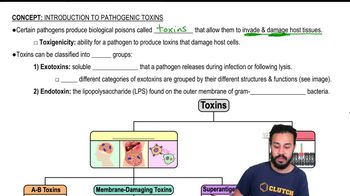
Among the listed organisms, Neisseria meningitidis is Gram-negative and produces endotoxins. The others (S. pyogenes, L. monocytogenes, C. tetani, C. botulinum) are Gram-positive and cause disease mainly through exotoxins, not endotoxins.
Recommended video:
Guided course
03:40
Introduction to Pathogenic Toxins