Ch. 25 - Pathogenic RNA Viruses
Bauman - Microbiology with Diseases by Taxonomy 6th Edition
Bauman6th EditionMicrobiology with Diseases by TaxonomyISBN: 9780134832302Not the one you use?Change textbook
Chapter 25, Problem 1

What viral family causes each of these diseases? (A family may be used more than once.)


1. _____Myocarditis
2. _____Colorado tick fever
3. _____Rabies
4. _____Influenza
5. _____Dengue fever
6. _____German measles
7. _____Acute gastroenteritis
8. _____Ebola virus
9. _____RSV
10. _____Western equine encephalitis
11. _____No known disease


A. Rhabdoviridae
B. Paramyxoviridae
C. Reoviridae
D. Coronaviridae
E. Togaviridae
F. Flaviviridae
G. Orthomyxoviridae
H. Orphan virus
I. Caliciviridae
J. Filoviridae
K. Picornaviridae

Verified step by step guidance
1
Step 1: Understand that each disease is caused by a virus belonging to a specific viral family. Your task is to match each disease with the correct viral family from the given list.
Step 2: Recall or research the common viral families associated with each disease. For example, Myocarditis can be caused by viruses from several families, but commonly enteroviruses (Picornaviridae) are involved.
Step 3: For each disease, identify the viral family based on known microbiological knowledge: for instance, Colorado tick fever is caused by a virus in the Reoviridae family, Rabies by Rhabdoviridae, Influenza by Orthomyxoviridae, and so on.
Step 4: Use the process of elimination and cross-reference to ensure that each disease is matched with the most appropriate viral family. Note that some families may be used more than once, so do not restrict yourself to unique assignments.
Step 5: For the disease labeled 'No known disease,' assign the 'Orphan virus' family, which refers to viruses not currently associated with any known disease.

Verified video answer for a similar problem:

This video solution was recommended by our tutors as helpful for the problem above.
Video duration:
2m
Was this helpful?

Key Concepts

Here are the essential concepts you must grasp in order to answer the question correctly.

Viral Families and Their Characteristics

Viral families group viruses based on shared structural features, genome type, and replication methods. Understanding these families helps identify which viruses cause specific diseases, as each family has characteristic hosts, transmission modes, and disease patterns.
Recommended video:
Guided course
05:12
Persistent Viral Infections

Disease-Virus Association

Each viral disease is caused by viruses from specific families. Recognizing the link between a disease and its viral family is essential for diagnosis, treatment, and epidemiology. For example, rabies is caused by Rhabdoviridae, while influenza is caused by Orthomyxoviridae.
Recommended video:
Guided course
04:57
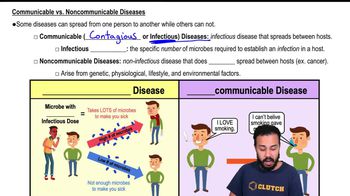
Communicable vs. Noncommunicable Diseases

Orphan Viruses and Their Significance

Orphan viruses are viruses not currently associated with any known disease. Identifying these helps differentiate pathogenic viruses from non-pathogenic ones, which is important in virology research and understanding viral ecology.
Recommended video:
Guided course
04:36
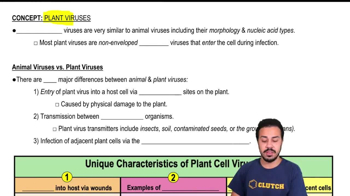
Plant Viruses