
The patient in room 519 exhibits yellowing skin and eyes, and it is suspected among the nursing staff that the diagnosis will be some kind of viral hepatitis. Make a chart of five kinds of hepatitis mentioned in this chapter, the infecting pathogen, how the patient might have become infected, and the relative degree of seriousness.
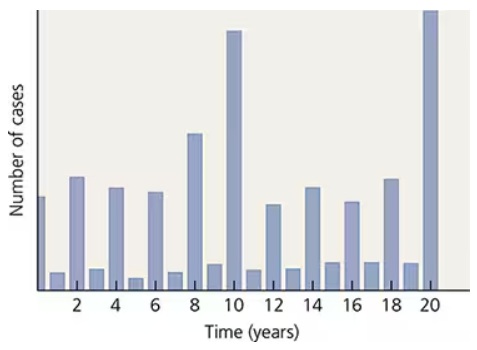
Label the flu epidemics. How can you best explain the biennial fluctuation in the number of cases? How can you explain the epidemics?

Verified step by step guidance
Verified video answer for a similar problem:
Key Concepts
Epidemiology of Influenza
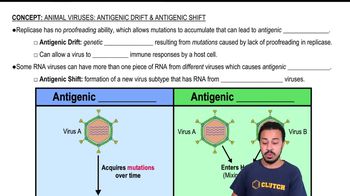
Antigenic Drift and Shift
Population Immunity and Biennial Fluctuation
Young Luis has skin lesions. His mother knows from microbiology class that five childhood diseases can produce spots. Name those five diseases and the viruses that cause each. List some questions to ask to determine which of these viruses Luis has.
The smallest animal viruses are in the family ___________.
a. Caliciviridae
b. Astroviridae
c. Togaviridae
d. Picornaviridae
What viral family causes each of these diseases? (A family may be used more than once.)
1. _____Myocarditis
2. _____Colorado tick fever
3. _____Rabies
4. _____Influenza
5. _____Dengue fever
6. _____German measles
7. _____Acute gastroenteritis
8. _____Ebola virus
9. _____RSV
10. _____Western equine encephalitis
11. _____No known disease
A. Rhabdoviridae
B. Paramyxoviridae
C. Reoviridae
D. Coronaviridae
E. Togaviridae
F. Flaviviridae
G. Orthomyxoviridae
H. Orphan virus
I. Caliciviridae
J. Filoviridae
K. Picornaviridae
_____All infections of polio are crippling.
What do viruses in the families Picornaviridae, Caliciviridae, Astroviridae, Coronaviridae, Togaviridae, Flaviviridae, and Retroviridae have in common?
a. They are arboviruses.
b. They are nonpathogenic.
c. They have positive single-stranded RNA genomes.
d. They have negative single-stranded RNA genomes.
