
Ch. 7 - Microbial Genetics
Bauman - Microbiology with Diseases by Taxonomy 6th Edition
Bauman6th EditionMicrobiology with Diseases by TaxonomyISBN: 9780134832302Not the one you use?Change textbook
Chapter 7, Problem 14

Which of the following are called “jumping genes”?


a. Hfr cells
b. Transducing phages
c. Palindromic sequences
d. Transposons

Verified step by step guidance
1
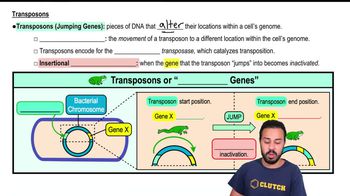
Understand the term "jumping genes" refers to DNA sequences that can move or transpose themselves to different positions within the genome of a single cell, which can cause mutations and change the cell's genetic identity.
Review each option: Hfr cells are bacterial cells with a high frequency of recombination, transducing phages are viruses that transfer bacterial DNA between cells, palindromic sequences are DNA sequences that read the same forward and backward, and transposons are DNA elements that can move within the genome.
Identify that the key characteristic of "jumping genes" is the ability to move or transpose within the genome, which matches the behavior of transposons.
Conclude that among the options, transposons are the elements known as "jumping genes" because they can change their position within the genome.
Summarize that the correct answer is the option corresponding to transposons.

Verified video answer for a similar problem:

This video solution was recommended by our tutors as helpful for the problem above.
Video duration:
1m
Was this helpful?

Key Concepts

Here are the essential concepts you must grasp in order to answer the question correctly.

Transposons

Transposons, often called 'jumping genes,' are DNA sequences that can move from one location to another within a genome. This mobility allows them to cause mutations and genetic variation. They play a significant role in genome evolution and can be found in both prokaryotic and eukaryotic organisms.
Recommended video:
Guided course
04:19
Transposons in Prokaryotes

Hfr Cells

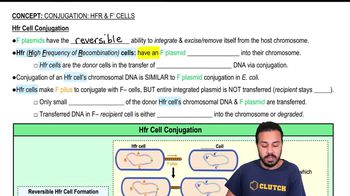
Hfr (High frequency recombination) cells are bacterial cells with the F plasmid integrated into their chromosome. They can transfer chromosomal genes to a recipient during conjugation but are not related to mobile genetic elements like transposons.
Recommended video:
Guided course
09:41
Hfr Cell Conjugation

Transducing Phages

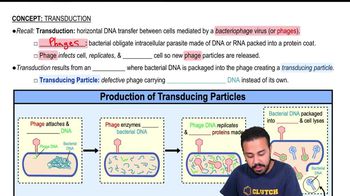
Transducing phages are bacteriophages that carry bacterial DNA from one cell to another via transduction. They facilitate horizontal gene transfer but do not move within the genome like transposons.
Recommended video: