Ch. 2 - Chemical Principles
Tortora - Microbiology: An Introduction 14th Edition
Tortora14th EditionMicrobiology: An IntroductionISBN: 9780138200398Not the one you use?Change textbook
Chapter 2, Problem 7

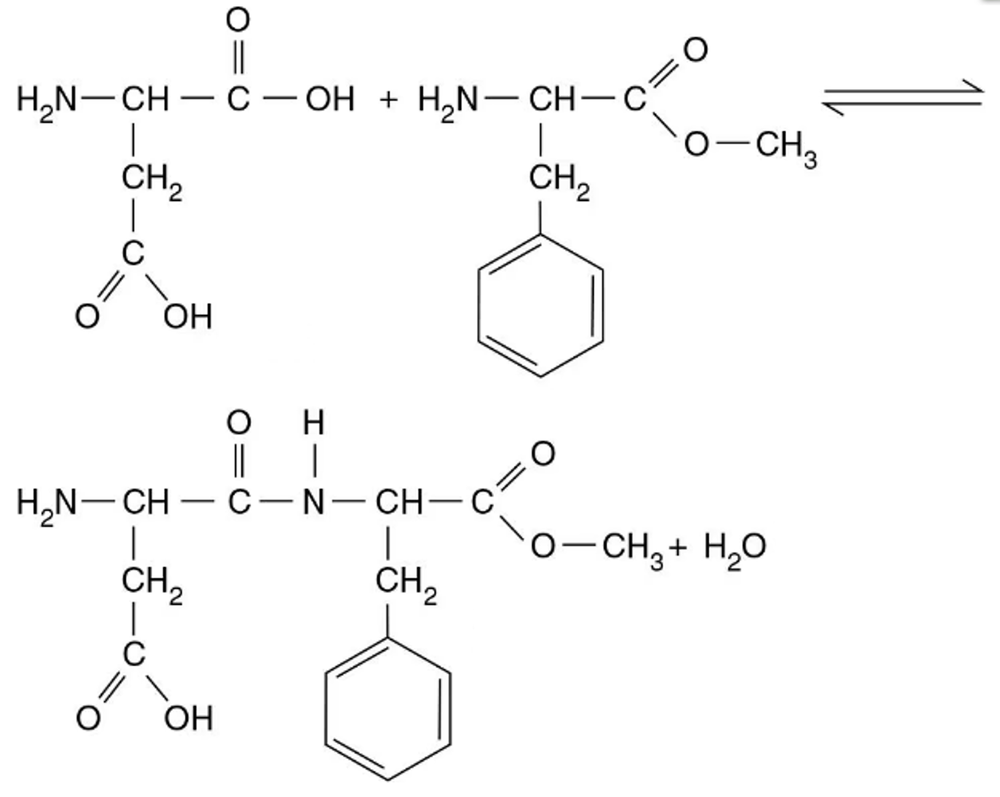
The artificial sweetener aspartame, or NutraSweet®, is made by joining aspartic acid to methylated phenylalanine, as shown in the following.
Chemical structures showing aspartic acid and methylated phenylalanine forming aspartame with peptide bond and water molecule.
a. What types of molecules are aspartic acid and phenylalanine?
b. What direction is the hydrolysis reaction (left to right or right to left)?
c. What direction is the dehydration synthesis reaction?
d. Circle the atoms involved in the formation of water.
e. Identify the peptide bond.

Verified step by step guidance
1
Step 1: Identify the types of molecules aspartic acid and phenylalanine are. Both are amino acids, which are the building blocks of proteins. Aspartic acid is an acidic amino acid with a carboxyl side chain, and phenylalanine is a nonpolar, aromatic amino acid.
Step 2: Understand the hydrolysis reaction direction. Hydrolysis is the process of breaking a bond by adding water. In the context of aspartame, hydrolysis breaks the peptide bond between aspartic acid and methylated phenylalanine, so the reaction proceeds from the dipeptide (right) to the individual amino acids (left).
Step 3: Determine the direction of the dehydration synthesis reaction. Dehydration synthesis (also called condensation) forms a peptide bond by removing a water molecule. This reaction proceeds from the individual amino acids (left) to the dipeptide (right).
Step 4: Identify and circle the atoms involved in the formation of water during the dehydration synthesis. Typically, this involves the hydroxyl group (-OH) from the carboxyl end of one amino acid and a hydrogen atom (H) from the amino group (-NH2) of the other amino acid. These combine to form water (H2O).
Step 5: Locate the peptide bond in the molecule. The peptide bond is the covalent bond formed between the carbon atom of the carboxyl group of one amino acid and the nitrogen atom of the amino group of the adjacent amino acid. It is typically represented as -C(=O)-NH-.

Verified video answer for a similar problem:

This video solution was recommended by our tutors as helpful for the problem above.
Video duration:
1m
Was this helpful?

Key Concepts

Here are the essential concepts you must grasp in order to answer the question correctly.

Amino Acids as Building Blocks of Proteins

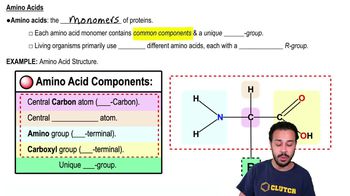
Aspartic acid and phenylalanine are amino acids, the fundamental units that make up proteins. Each amino acid contains an amino group, a carboxyl group, and a unique side chain that determines its properties. Understanding their structure is essential for recognizing how they link to form peptides.
Recommended video:

Dehydration Synthesis and Hydrolysis Reactions

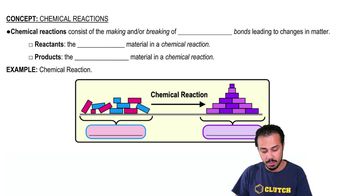
Dehydration synthesis is a chemical reaction where two molecules join by removing a water molecule, forming a covalent bond. Hydrolysis is the reverse, where water breaks the bond, splitting the molecule. These reactions are key to forming and breaking peptide bonds between amino acids.
Recommended video:
Guided course
01:56
Chemical Reactions

Peptide Bond Formation

A peptide bond is a covalent bond formed between the carboxyl group of one amino acid and the amino group of another during dehydration synthesis. This bond links amino acids into peptides or proteins and is characterized by the specific atoms involved in the bond and the water molecule released.
Recommended video: