
Ch. 2 - Chemical Principles
Tortora - Microbiology: An Introduction 14th Edition
Tortora14th EditionMicrobiology: An IntroductionISBN: 9780138200398Not the one you use?Change textbook
Chapter 2, Problem 7

Classify each of the molecules on the left as an acid, base, or salt. The dissociation products of the molecules are shown to help you.
HNO3 → H+ + NO⁻3
a. Acid
b. Base
c. Salt

Verified step by step guidance
1
Identify the molecule given: HNO₃ (nitric acid).
Look at the dissociation products: HNO₃ → H⁺ + NO₃⁻.
Recall that an acid is a molecule that donates a proton (H⁺) when it dissociates in water.
Since HNO₃ dissociates to release H⁺ ions, classify it as an acid.
Confirm that the other product, NO₃⁻, is the conjugate base formed after the acid donates the proton.

Verified video answer for a similar problem:

This video solution was recommended by our tutors as helpful for the problem above.
Was this helpful?

Key Concepts

Here are the essential concepts you must grasp in order to answer the question correctly.

Acids, Bases, and Salts Classification

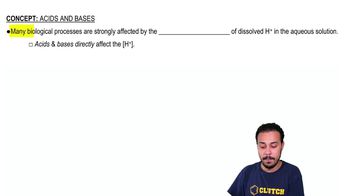
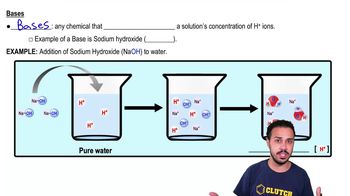
Acids are substances that release hydrogen ions (H⁺) when dissolved in water, bases release hydroxide ions (OH⁻), and salts are formed from the neutralization of acids and bases, typically dissociating into cations and anions other than H⁺ or OH⁻.
Recommended video:
Guided course
01:29
Acids and Bases

Dissociation of Molecules in Water

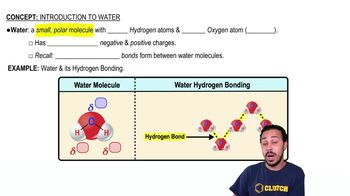
Dissociation refers to the process where molecules split into ions in solution. Understanding which ions are produced helps classify the molecule as an acid, base, or salt based on the presence of H⁺ or OH⁻ ions.
Recommended video:
Guided course
01:54
Introduction to Water

Nomenclature and Ion Identification

Recognizing common ions such as H⁺ (hydrogen ion) and NO₃⁻ (nitrate ion) is essential. For example, HNO₃ dissociates into H⁺ and NO₃⁻, indicating it is an acid because it releases H⁺ ions in solution.
Recommended video: