Ch. 8 - Microbial Genetics
Tortora - Microbiology: An Introduction 14th Edition
Tortora14th EditionMicrobiology: An IntroductionISBN: 9780138200398Not the one you use?Change textbook
Chapter 8, Problem 1

Briefly describe the components of DNA, and explain its functional relationship to RNA and protein.

Verified step by step guidance
1
Start by identifying the basic components of DNA: it is composed of nucleotides, each consisting of three parts — a phosphate group, a deoxyribose sugar, and one of four nitrogenous bases (adenine, thymine, cytosine, or guanine).
Explain the structure of DNA as a double helix formed by two complementary strands held together by hydrogen bonds between the nitrogenous bases (A pairs with T, and C pairs with G).
Describe the functional relationship between DNA and RNA: DNA serves as the template for RNA synthesis during transcription, where the sequence of bases in DNA is copied into a complementary RNA sequence.
Clarify that RNA acts as the intermediary molecule that carries genetic information from DNA to the ribosomes, where protein synthesis occurs.
Explain that proteins are synthesized through translation, where the RNA sequence is decoded to assemble amino acids into a polypeptide chain, thus linking DNA's genetic code to functional proteins.

Verified video answer for a similar problem:

This video solution was recommended by our tutors as helpful for the problem above.
Video duration:
1m
Was this helpful?

Key Concepts

Here are the essential concepts you must grasp in order to answer the question correctly.

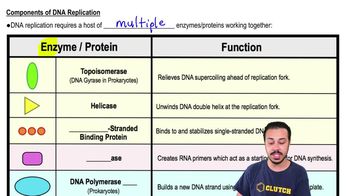
Components of DNA

DNA is composed of nucleotides, each containing a phosphate group, a deoxyribose sugar, and one of four nitrogenous bases: adenine, thymine, cytosine, or guanine. These nucleotides form a double helix structure with complementary base pairing (A-T and C-G), which stores genetic information.
Recommended video:
Guided course
04:47
Components of DNA Replication

Relationship between DNA and RNA

RNA is synthesized from DNA through transcription, where a complementary RNA strand is made using DNA as a template. Unlike DNA, RNA contains ribose sugar and uracil instead of thymine, and it serves as a messenger carrying genetic instructions from DNA to the protein synthesis machinery.
Recommended video:
Guided course
05:59
Symbiotic Relationships

DNA, RNA, and Protein Functional Relationship

DNA stores genetic information, RNA transmits this information, and proteins perform cellular functions. Through the processes of transcription and translation, the sequence of DNA is converted into RNA, which then guides the assembly of amino acids into proteins, enabling gene expression.
Recommended video:
Guided course
03:35
Membrane Protein Functions