

Ch. 11 - Characterizing and Classifying Prokaryotes
Bauman - Microbiology with Diseases by Taxonomy 6th Edition
Bauman6th EditionMicrobiology with Diseases by TaxonomyISBN: 9780134832302Not the one you use?Change textbook
Chapter 11, Problem 9

Describe the special features of snapping division that distinguish it from regular binary fission.

Verified step by step guidance
1
Begin by defining regular binary fission: it is a common method of asexual reproduction in bacteria where the cell grows, duplicates its DNA, and divides evenly into two identical daughter cells.
Explain that snapping division is a modified form of binary fission observed in certain bacteria, such as Corynebacterium species, which differs in the way the cell wall breaks during division.
Describe the key feature of snapping division: the inner cell membrane divides normally, but the outer cell wall does not split evenly. Instead, it remains intact and then suddenly 'snaps' apart at a hinge point, causing the daughter cells to remain attached at an angle.
Highlight how this snapping mechanism results in characteristic angular arrangements of cells, such as V-shaped or palisade formations, which are distinct from the typical side-by-side arrangement seen in regular binary fission.
Summarize that the special features of snapping division include the uneven breakage of the cell wall, the sudden snapping action, and the resulting unique cell arrangements, distinguishing it from the smooth and symmetrical division in regular binary fission.

Verified video answer for a similar problem:

This video solution was recommended by our tutors as helpful for the problem above.
Video duration:
2m
Was this helpful?

Key Concepts

Here are the essential concepts you must grasp in order to answer the question correctly.

Snapping Division Mechanism

Snapping division is a unique form of bacterial cell division where the outer cell wall layer breaks unevenly, causing the daughter cells to remain attached by a hinge-like structure. This contrasts with regular binary fission, where the cell divides symmetrically and separates completely.
Recommended video:
Guided course
01:59
Introduction to Avoiding Host Defense Mechanisms

Cell Wall Structure and Role

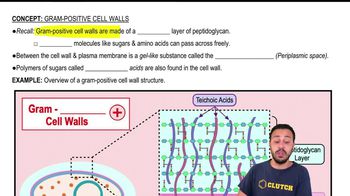
In snapping division, the cell wall consists of an inner layer that grows and divides normally, and a rigid outer layer that snaps open. The differential behavior of these layers is crucial, as the outer wall's sudden breakage leads to the characteristic snapping and partial attachment of daughter cells.
Recommended video:
Guided course
02:59
Gram-Positive Cell Walls

Biological Significance and Examples

Snapping division is observed in certain Gram-positive bacteria like Corynebacterium and Arthrobacter. This division method influences colony morphology and may aid in environmental adaptation by maintaining cell clusters, differing from the complete separation seen in typical binary fission.
Recommended video:
Guided course
02:21
Cell Envelope & Biological Membranes Example 1