Ch. 11 - Characterizing and Classifying Prokaryotes
Bauman - Microbiology with Diseases by Taxonomy 6th Edition
Bauman6th EditionMicrobiology with Diseases by TaxonomyISBN: 9780134832302Not the one you use?Change textbook
Chapter 11, Problem 9

For each of the following statements that is true, write “true” in the blank. For each statement that is false, write the word(s) that should be substituted for the underlined word(s) to make the statement correct.
__________ A giant bacterium that is large enough to be seen without a microscope is Selenomonas.

Verified step by step guidance
1
Step 1: Understand the statement and identify the key claim. The statement says that a giant bacterium visible without a microscope is Selenomonas.
Step 2: Recall or research the characteristics of Selenomonas. Selenomonas is a genus of bacteria, but it is not known for being giant or visible to the naked eye.
Step 3: Identify the correct giant bacterium that is large enough to be seen without a microscope. One well-known example is Epulopiscium fishelsoni, a giant bacterium visible to the naked eye.
Step 4: Substitute the incorrect term 'Selenomonas' with the correct term 'Epulopiscium' to make the statement true.
Step 5: Conclude that the corrected statement should read: 'A giant bacterium that is large enough to be seen without a microscope is Epulopiscium.'

Verified video answer for a similar problem:

This video solution was recommended by our tutors as helpful for the problem above.
Video duration:
1m
Was this helpful?

Key Concepts

Here are the essential concepts you must grasp in order to answer the question correctly.

Giant Bacteria

Giant bacteria are unusually large bacterial cells visible to the naked eye, such as Thiomargarita namibiensis. These bacteria challenge the typical microscopic size range of bacteria and have unique adaptations to support their large size.
Recommended video:
Guided course
06:18
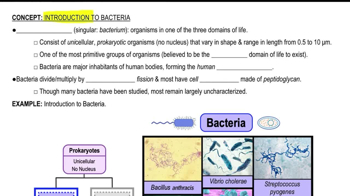
Introduction to Bacteria

Selenomonas Characteristics

Selenomonas is a genus of crescent-shaped, anaerobic bacteria commonly found in the oral cavity and rumen. They are not giant bacteria and are microscopic, so they cannot be seen without a microscope.
Recommended video:
Guided course
05:09
Intro to Characteristics of Infectious Disease

Correct Identification of Giant Bacteria

The correct example of a giant bacterium visible without a microscope is Thiomargarita namibiensis, not Selenomonas. Understanding which bacteria are classified as giant helps in accurately evaluating statements about bacterial size.
Recommended video:
Guided course
06:18
Introduction to Bacteria