Ch. 5 - Microbial Metabolism
Bauman - Microbiology with Diseases by Taxonomy 6th Edition
Bauman6th EditionMicrobiology with Diseases by TaxonomyISBN: 9780134832302Not the one you use?Change textbook
Chapter 5, Problem 2

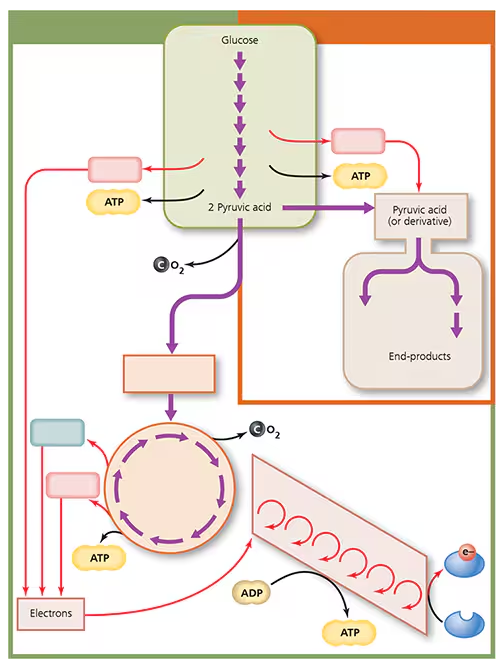
Label the diagram below to indicate acetyl-CoA, electron transport chain, FADH2, fermentation, glycolysis, citric acid cycle, NADH, and respiration. Indicate the net number of molecules of ATP that could be synthesized at each stage during bacterial respiration of one molecule of glucose.
Diagram illustrating glucose breakdown to pyruvic acid, ATP production, electron transport chain, and fermentation pathways.

Verified step by step guidance
1
Identify the stages of glucose metabolism in the diagram: Glycolysis, formation of Acetyl-CoA, Citric Acid Cycle, Electron Transport Chain, and Fermentation.
Label 'Glycolysis' at the top center where glucose is converted into 2 pyruvic acid molecules, noting that this process produces a net gain of 2 ATP molecules and 2 NADH molecules.
Label 'Acetyl-CoA' at the box immediately after pyruvic acid where pyruvate is converted into Acetyl-CoA, which enters the Citric Acid Cycle; this step also produces NADH.
Label the 'Citric Acid Cycle' at the circular pathway, indicating that it produces ATP, NADH, and FADH2 molecules; typically, 2 ATP molecules are produced per glucose molecule here.
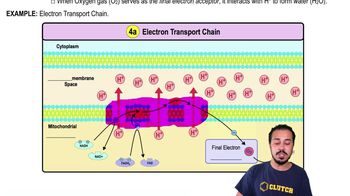
Label the 'Electron Transport Chain' at the rectangular structure with red arrows, showing that NADH and FADH2 donate electrons here, leading to the production of a large amount of ATP through oxidative phosphorylation; also label 'Respiration' here as it requires oxygen.
Label 'Fermentation' in the box on the right where pyruvic acid is converted into end-products in the absence of oxygen, noting that fermentation produces no additional ATP beyond glycolysis.
Indicate the approximate net ATP yield at each stage: 2 ATP from glycolysis, 2 ATP from the citric acid cycle, and the majority of ATP (about 34) from the electron transport chain during aerobic respiration.

Verified video answer for a similar problem:

This video solution was recommended by our tutors as helpful for the problem above.
Video duration:
1m
Was this helpful?

Key Concepts

Here are the essential concepts you must grasp in order to answer the question correctly.

Glycolysis

Glycolysis is the initial metabolic pathway that breaks down one molecule of glucose into two molecules of pyruvic acid, producing a net gain of 2 ATP and 2 NADH molecules. It occurs in the cytoplasm and does not require oxygen, serving as the first step in both aerobic and anaerobic respiration.
Recommended video:

Citric Acid Cycle (Krebs Cycle) and Acetyl-CoA

After glycolysis, pyruvic acid is converted into acetyl-CoA, which enters the citric acid cycle. This cycle occurs in the bacterial cytoplasm and generates NADH, FADH2, and a small amount of ATP by oxidizing acetyl-CoA. These electron carriers are essential for the next stage, the electron transport chain.
Recommended video:

Electron Transport Chain and Respiration

The electron transport chain uses electrons from NADH and FADH2 to create a proton gradient across the membrane, driving ATP synthesis via oxidative phosphorylation. Oxygen acts as the final electron acceptor in aerobic respiration, allowing the production of a large amount of ATP compared to glycolysis and the citric acid cycle.
Recommended video:
Guided course
07:41
Electron Transport Chain