Ch. 5 - Microbial Metabolism
Bauman - Microbiology with Diseases by Taxonomy 6th Edition
Bauman6th EditionMicrobiology with Diseases by TaxonomyISBN: 9780134832302Not the one you use?Change textbook
Chapter 5, Problem 2

For the phrase given below, indicate the type of metabolism referred to, using the following choices:
a. Anabolism only
b. Both anabolism and catabolism (amphibolic)
c. Catabolism only


Includes dehydration synthesis reactions

Verified step by step guidance
1
Understand the key terms: Anabolism refers to the set of metabolic pathways that construct molecules from smaller units, often requiring energy input. Catabolism refers to the breakdown of molecules into smaller units, releasing energy. Amphibolic pathways involve both anabolic and catabolic processes.
Identify the phrase given: 'Includes dehydration synthesis reactions'. Dehydration synthesis is a chemical reaction where two molecules are joined together with the removal of a water molecule.
Recall that dehydration synthesis is a type of anabolic reaction because it builds larger molecules from smaller ones, requiring energy input.
Match the phrase to the correct metabolism type based on the definition: since dehydration synthesis builds molecules, it corresponds to anabolism only.
Conclude that the correct choice for the phrase 'Includes dehydration synthesis reactions' is 'a. anabolism only'.

Verified video answer for a similar problem:

This video solution was recommended by our tutors as helpful for the problem above.
Video duration:
1m
Was this helpful?

Key Concepts

Here are the essential concepts you must grasp in order to answer the question correctly.

Anabolism

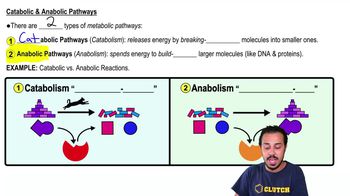
Anabolism refers to the set of metabolic pathways that build complex molecules from simpler ones, often requiring energy input. It includes processes like dehydration synthesis, where water is removed to form bonds, such as in the formation of proteins or polysaccharides.
Recommended video:
Guided course
03:25
Catabolic & Anabolic Pathways

Catabolism

Catabolism involves the breakdown of complex molecules into simpler ones, releasing energy stored in chemical bonds. This energy is then used to fuel cellular activities. Catabolic reactions typically involve hydrolysis, the addition of water to break bonds.
Recommended video:
Guided course
03:25
Catabolic & Anabolic Pathways

Dehydration Synthesis Reactions

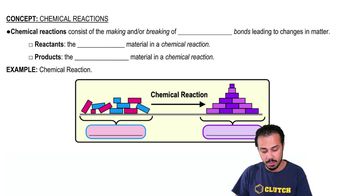
Dehydration synthesis is a chemical reaction where two molecules are joined together by removing a water molecule. This reaction is fundamental in anabolism for forming macromolecules like proteins, lipids, and carbohydrates.
Recommended video:
Guided course
01:56
Chemical Reactions